Vocabulary and Morphology Using Structured Word Inquiry
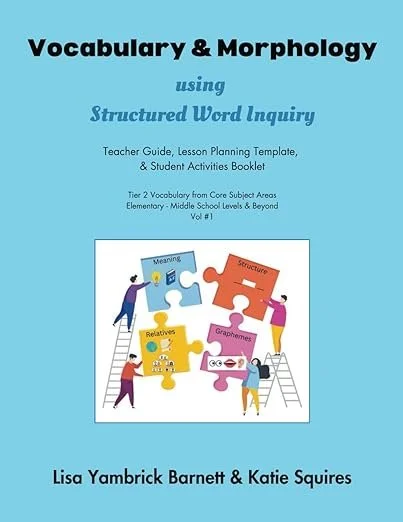
Vocabulary and Morphology using Structured Word Inquiry
by Lisa Yambrick Barnett and Katie Squires
A clear introduction for teachers who would like to explore Structured Word Inquiry
What is SWI?
Structured Word Inquiry (SWI) is an instructional approach that teaches spelling and reading (and more) by investigating the morphological structure of words, and their etymological roots.
English has a morphophonemic spelling system, which means that graphemes (letters or groups of letters) reflect both phonemes (individual ‘speech sounds’) and the morphological structure of words (prefixes, bases and suffixes). And, conversely, the structure of a word can affect how the graphemes are pronounced. SWI aims to teach how the English spelling system actually works rather than over-relying on phonics (matching phonemes to graphemes), which only partially explains the English spelling system.
(Take a look at this blog post for more information about morphophonemic orthography.)
Anyone who has explored SWI will have come across certain practices and tools that are used for teaching. These include word sums, morphological matrices, the ‘Four Questions’, and ‘Spelling-Out’. If you’ve ever wondered what these are, or want clarification on how to use them within SWI, Vocabulary and Morphology Using Structured Word Inquiry is a very clear introduction.
How the book is organised
Introduction
The authors, Lisa Barnett and Katie Squires, begin by describing how SWI changed their perspective, from viewing English spelling as ‘crazy’ to understanding how English orthography works:
“Once we began to investigate and seek evidence, we came to realise the purpose of spelling is not to represent sounds, but to represent meaning and link words historically through time. This forced a perspective shift and our new perspective transformed our thinking and teaching.”
They introduce the idea of SWI as an investigative approach in which the teacher does not have to know all the answers:
“The focus of an SWI lesson is on thinking critically in order to find evidence of morphemes and graphemes. It allows students to seek evidence to verify or nullify their hypotheses about how spelling is structured.”
Main concepts
The next section briefly outlines the main concepts within SWI, including:
The ‘Four Guiding Questions’ that can be used when investigating a word
Definitions of key terminology
An introduction to word sums, suffixing conventions, spelling out, and morphological matrices
Key information about Latin
Use of etymonline, and etymology trees
Links to research, videos and other useful information
Suggestions for activities
Vocabulary words in alphabetical order
The main part of the book shows teachers how to explore key vocabulary words, using the Four Questions as a basic framework for lessons. The entry for each word includes specific questions to ask students, detailed information about the structure, etymology and phonology of the word and its relatives, and ideas for games.
Worksheets
The final section provides a lesson planning template, and worksheet templates that can be used for word investigations.
The best bits
The best thing about this book is undoubtedly the specific examples of word investigations, including matrices, word sums, worksheets and games. These colourful examples really give a sense of how SWI works, and will be a great support for any educator who wants to try out the approach.
Words that are discussed include deposition, erosion, evidence, longitude and migration. These word-choices demonstrate that SWI does not shy away from tacking long words – in fact, building long words is at the heart of the approach!
As someone who has done a lot of ‘word-investigating’ myself, I still came across some new information in this book. For instance, the authors provide ‘Digging Deeper’ activities that are designed to add extra depth or challenge to lessons. One of these points out that some words from the <pose> word family have the suffix <-it> (e.g. deposit, deposits), while others have the suffix <-ite> (e.g. opposite, composition). This difference reflects their history: words with the <-ite> suffix came through French, while those with the <-it> suffix did not.
Who is it for?
I’d recommend this for anyone who wants to learn more about the SWI approach. Even if you don’t use all of the strategies and tools that are mentioned, it’s a thought-provoking read that will give you some ideas for new questions to ask and words to investigate!
Podcast Pairing
On the For the Love of Literacy podcast, Lisa Barnett and Katie Squires talk about how they met, what SWI is, and how to implement it. They give practical insights into how to use SWI to integrate teaching of phonics, morphology, vocabulary, comprehension and oral language.
Other resources
For more information on SWI, take a look at Dr Pete Bowers’ website, which has lots of videos and links to useful resources.
If you are interested in SWI, you may also like to explore the Literacy Intervention for Teens and Tweens (LIfTT). The LIfTT programme has a strong emphasis on using morphology and etymology to help students understand English orthography, and morphological matrices and word sums are important tools within the intervention.