The Wordhord and The Deorhord
The Wordhord and The Deorhord by Hana Videen
Fascinating snippets of Old English are woven together to create an insightful glimpse of Anglo-Saxon England
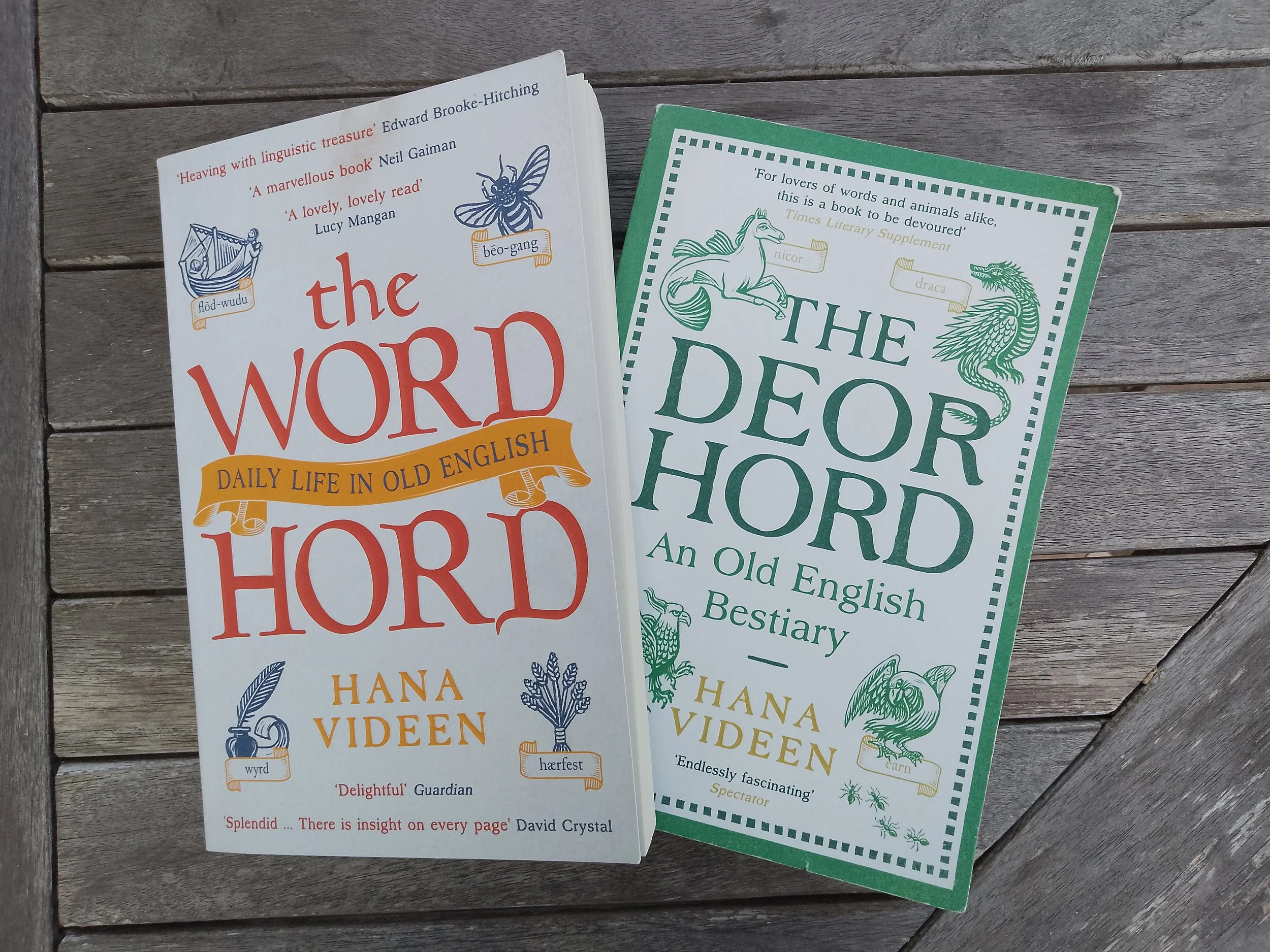
Over the last few years, my interest in etymology has changed from a primarily practical perspective – wanting to find out the origin of spellings so that I could explain them to my frustrated students – to a genuine curiosity about how the English language has changed over time, and how that connects to history and culture. So, I was looking forward to reading and reviewing these two books by Hana Videen over the summer holiday:
The Wordhord: Daily Life in Old English
The Deorhord: An Old English Bestiary
What are they about?
Both books are essentially collections of Old English words or phrases accompanied by explanations of their context and meaning, which lead to fascinating insights into how people thought and lived in early medieval England (or rather, the separate kingdoms that later became England).
As the author explains in The Wordhord (p. 14):
“Understanding a language is not just about knowing words and grammar: each language tells you something about the people who speak it, their culture, dreams and daily life, how they see the world and their place within it.”
How are the books organised?
The first chapter of The Wordhord is an accessible explanation of the difference between Old, Middle and Early Modern English, together with a brief discussion of the runic alphabet and the introduction of Latin letters.
After that, each chapter is organised around a topic or theme. A chatty and informative introduction to a wide range of words and phrases is followed by a ‘wordhord’ that lists each word alongside its definition and its pronunciation. For The Wordhord, themes includes ‘Eating and Drinking’, ‘Learning and Working’, ‘Travel’ and more. For The Deorhord, as you would expect in a bestiary, each chapter is themed around an animal, whether that is an everyday creature such as a dove, or a fantastical beast like a dragon. (In Old English, dēor referred to all kinds of animal – the meaning only later narrowed to become the word modern English word deer.)
The best bits
Both The Wordhord and The Deorhord convey the author’s genuine pleasure in learning Old English, and her enthusiasm is infectious! As with many people who have studied Old English, Hana is particularly keen on ‘kennings’, as described here (p. 125):
“A kenning is a metaphorical compound noun used frequently in Old English poetry. To create a kenning, combine two ordinary nouns to create a compound that is itself a sort of riddle. A ‘day-candle’ is the sun, ‘whale-road’ the ocean.”
I found kennings such as hord-loca (hoard locker, ‘mind’) and bān-hūs (bone-house, ‘body’) both evocative and satisfying – perhaps because by interpreting the kenning, you feel a mental connection with the originator from over a thousand years ago.
With this kind of book, there are always going to be a few words or phrases that particularly take your fancy. For me, a few favourites were:
wæfer-gange (weaver-walker, meaning ‘spider’)
an-stapa (one-stepper, meaning ‘lone wanderer’)
wil-cuma (well-comer, meaning ‘one whose coming is pleasant/a welcome person or thing’
reord-berend (speech-bearer, also meaning ‘human’).
As the corpus of Old English is relatively small (about 3.5 million words), there are many words or phrases that occur only once or a few times, and their meaning can’t be pinned down with certainty. Hana Videen does a great job of describing the contexts in which these words occur, so that we can consider the different interpretations for ourselves.
The less good
I definitely preferred The Wordhord to The Deorhord. This is partly because I found the subject matter more appealing. I’m more interested in finding out about people’s professions, when and what they ate, and how they entertained themselves (all in The Wordhord) than I am in learning about how panthers or dragons were perceived in medieval times (in The Deorhord). But that may be a matter of personal taste.
I also felt that, while the The Wordhord was packed with interesting facts and curiosities, The Deorhord was perhaps struggling to fulfil the page count. There was some crossover between the books too, particularly the section on the fastitocalon, a strange fish/whale that disguises itself as an island and lures sailors to their deaths – this section even has the same subheading and illustration.
Who are they for?
I’d recommend The Wordhord to anyone with an interest in English etymology. It’s a quick read that is amusingly-written and interesting, giving a glimpse of the style, sounds and rhythm of Old English. I’d also recommend The Deorhord, but only to those with a specific interest in animals or myths, or those who have a really keen interest in Old English.
Podcast pairing
If you want to get a ‘feel’ for Old English poetry, try listening to Episode 37 of The History of English podcast, which explains its rhythmic and alliterative structure.
Etymology can be a fantastic tool for helping older children and teenagers to learn spelling. To find out more about how etymology can be part of a literacy intervention, take a look at the Literacy Intervention for Teens and Tweens (LIfTT).