Leveled Reading, Leveled Lives
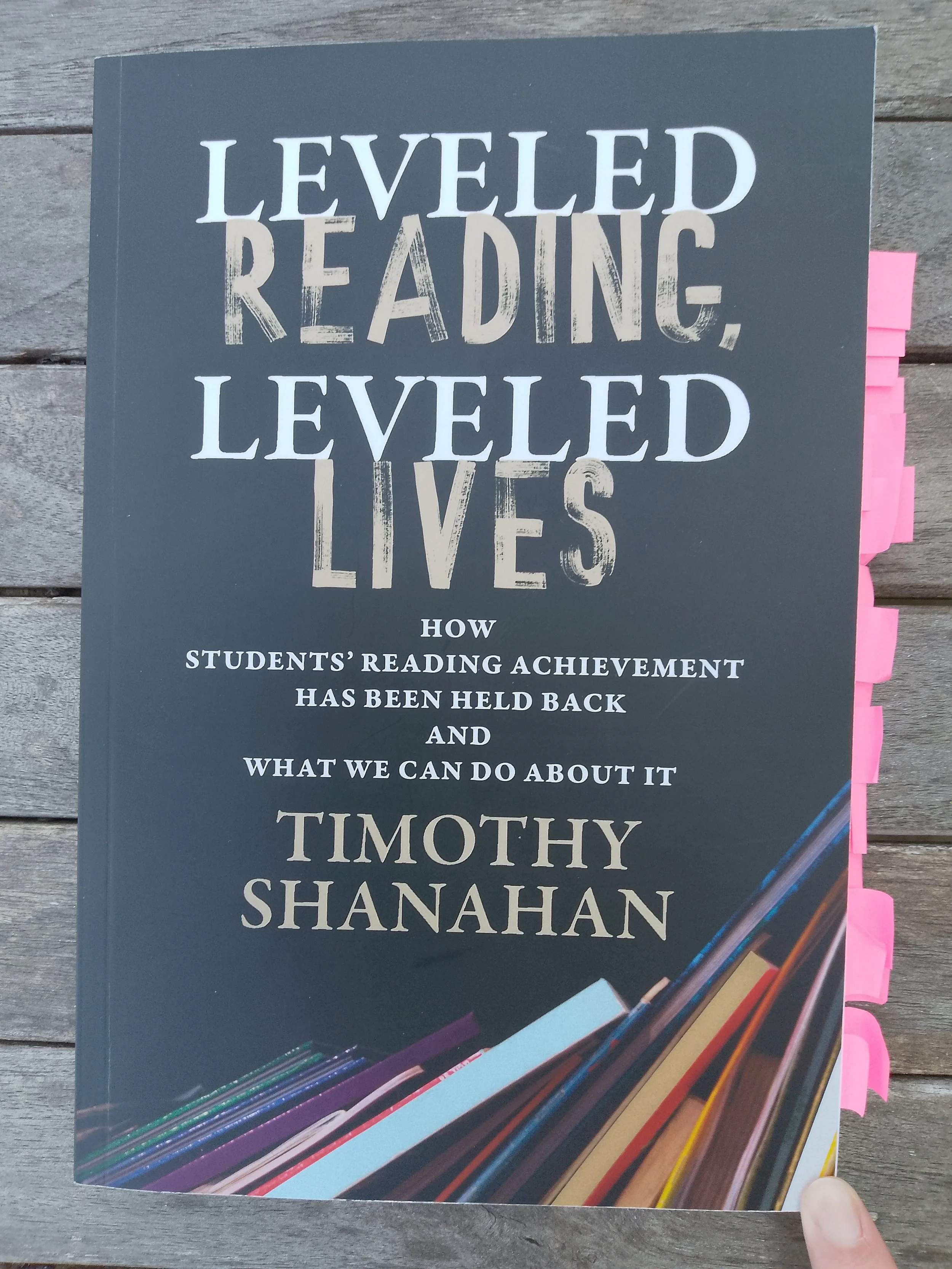
Leveled Reading, Leveled Lives: How students’ reading achievement has been held back and what we can do about it
by Timothy Shanahan
Timothy Shanahan presents a compelling case that students should be taught with challenging texts
Leveled Reading, Leveled Lives, by the well-known US literacy specialist, Tim Shanahan, has one key message:
Stop teaching pupils using ‘instructional-level texts’ and teach them using challenging texts.
At 165 pages (excluding references), it’s a fairly long read for such a short message, but, as you’d expect from Tim Shanahan, it’s well-written, clear, packed with references to the research, and it sets out the practical implications for teaching.
What are ‘instructional-level texts’?
First of all, what is meant by ‘instructional-level texts’? Well, defining the term accurately turns out to be part of the problem, as the author explains in Chapter 4. But the general idea is that instructional-level texts are texts that a pupil can already understand easily, perhaps with 95–98% word-reading accuracy.
Why do US teachers use instructional-level texts?
In US classrooms, pupils are often split into small ability-based groups in which they are assigned texts at their instructional level, and the teacher will work with each group separately for a small portion of the day.
Arguments that have been used to support the use of instructional-level texts include:
motivation (difficult texts would turn pupils off reading)
keeping learning manageable by progressing in small steps
improved behaviour because pupils are engaged with a text that they can understand
avoiding the potential emotional problems that could be caused by pupils being confronted by a text for which they are not ‘ready’.
But, as Shanahan explains (at some length) in Chapters 1 to 4, the evidence for using instructional-level texts for classroom teaching simply doesn’t exist.
What are the problems with using instructional-level texts?
As far as I know – and I’m not a primary specialist – classroom teaching using instructional-level texts is much less pervasive in the UK than it appears to be in the US. So, UK readers may want to skim the first few chapters, which deal with the history of the US education system and specific issues with instructional-level texts.
In these initial chapters, Shanahan describes in detail the problems with teaching with instructional level text. Here’s my quick summary of the main points:
There’s a lot of uncertainty in assessing pupils’ comprehension to identify the appropriate instructional level.
There’s a lot of uncertainty in assessing the average complexity of a text.
These two sources of error mean that matching the text to the reader is unlikely to be achieved with any degree of precision.
Complexity within a text often varies hugely from section to section. Referencing a study from Elfrieda Hiebert, Shanahan points out that within a single chapter of Pride and Prejudice, 125-word excerpts of text had Lexiles (complexity ratings) that ranged from 670 (beginning grade 3) to 1310 (college). As he says (p. 76):
“This amount of variation requires a major alteration to the instructional level theory and all the authoritative pronouncements about the importance of placing students at just the right level to avoid frustration. Given these measurement problems … students will be placed at their reading levels only a fraction of the time.”
There are only a few studies that compare the learning outcomes of using instructional-level versus grade-level texts, and these revealed no consistent benefit to being taught using instructional-level texts.
Teaching using instructional-level texts requires small-group teaching that significantly reduces the time that teachers have for whole-class teaching.
By limiting struggling students to texts with less complexity, we deprive them of the opportunity to catch up with their peers.
Guidance for how to teach pupils using challenging text
Chapters 5, 7, 8 and 9 present the evidence for the best ways to use challenging text in class, based on the idea that:
“Texts that students cannot easily comprehend on their own present obvious opportunities for learning, since any barrier to understanding can be a propitious target of instruction.” (p. 136)
For each teaching recommendation, Shanahan reviews the evidence and discusses implementation. He recommends practices such as:
Read the text before the lesson to identify likely barriers to comprehension.
Scaffold vocabulary, possibly by pre-teaching words, but words that can be figured out from the context should not be pre-taught.
Scaffold syntax, for example by teaching paraphrasing, and by dividing and simplifying complex sentences.
Ask comprehension questions to check that students have understood meaningful connections between words within the text (e.g. anaphor).
Familiarise students with text structure.
Teach comprehension monitoring.
Guidance for teaching beginning readers and older struggling readers
The author does acknowledge that matching text-level to readers’ ability may be helpful in the very early stages of reading, when decodable books or books with controlled vocabulary may be appropriate. Chapter 6 assesses the types of texts that may be best for these pupils, though Shanahan concludes that:
“Despite the amount of scholarly consideration devoted to these issues, it is still not possible to say definitively what the best text choices are for beginners.” (p. 104)
This chapter also briefly looks at texts and strategies to support older students. For those who lack basic decoding skills, Shanahan recommends explicit phonics instruction supported by decodable and vocabulary-controlled texts. But for those beyond this stage, he suggests “an amalgam of morphology, spelling, and phonics” (p. 110), accompanied by scaffolding of vocabulary, and fluency training.
What I’d like to see more of
Although this book successfully makes the case for using challenging books for most classroom teaching, I would have liked a detailed review of the evidence on how different texts may be appropriate for readers at different stages and in different contexts. For example:
Do readers who are learning phonics need texts that match their decoding ability? (This is partially addressed in Chapter 6.)
Are there stages in learning when it’s appropriate to read a large quantity of relatively easy books? For example, when pupils consolidate their reading skills (that is, after reasonable decoding skills have been acquired but before a pupil can read fluently), it seems likely that independent reading of ‘easy’ books has an important role in developing automaticity.
Shanahan argues against librarians constraining pupils choice of reading (p. 156), but what about when books are being taken home specifically for the purpose of reading practice, either independently or with the support of parents? On p. 94, he states that “It may make sense to protect against too much difficulty when it comes to seatwork, homework or independent learning”, but he gives no further guidance.
So, I think there’s scope for a nuanced analysis that probes matching texts and tasks to different stages and different learning contexts.
Who is this book for?
This book is definitely aimed at a US readership, but there’s plenty of useful guidance for any teacher who is looking to develop how they use challenging texts in the classroom or in an intervention.
I offer support and training to teachers and home educators who are teaching adolescents to improve their literacy. To find out more, click below: