Once Upon A Word
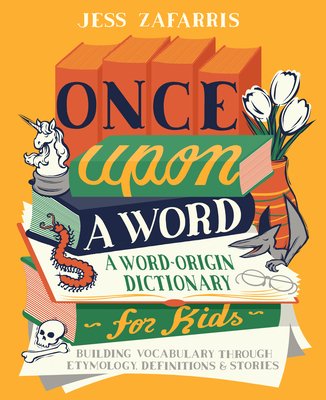
Once Upon A Word: A Word-Origin Dictionary for Kids
by Jess Zafarris
An attractive book for introducing children and teenagers to etymology
This is a beautifully-produced etymological dictionary for children or teenagers. The author, Jess Zafarris, has also written etymological books for adults, and co-hosts the entertaining and informative Words Unravelled podcast.
How the book is organised
Part 1
Part 1 begins with a brief introduction to the origins of language, accompanied by an explanation of etymology and what it means to be a ‘word detective’.
Next, there is an excellent summary of the main historical influences on the English language, from proto-Indo-European to Modern English. This includes acknowledging that sometimes language change is not a peaceful process:
“It’s important to remember that invaders often took language, culture, and resources in ways that harmed indigenous civilizations.
By studying word history, we learn more about important cultures that were lost or harmed during these conflicts. This knowledge helps us avoid future mistakes while celebrating different ideas, cultures, and languages.”
The next section introduces the basic concepts of ‘root’, ‘prefix’ and ‘suffix’. This is followed by a helpful list of Latin-based roots, Greek-based roots, and common prefixes and suffixes.
Part 2
Part 2 forms the main part of the book, and is an etymological dictionary arranged in alphabetical order. Each entry includes the pronunciation, part of speech and definition of the word, as well as historical and etymological information. These dictionary entries are very well-written, and are child-friendly without being condescending.
Naturally, a book of this length (256 pages) is not going to be comprehensive, so if you are searching for a specific word, you may not find it. Nevertheless, the words that have been included are carefully-chosen, and most would fit Beck and McKeown’s concept of ‘Tier 2’ words – that is, those that lie between Tier 1 everyday words (e.g. dog, cup) and Tier 3 subject-specific technical words (tributary, mitosis). In addition, the author has included some fun words such as elf, nerd, grinch and werewolf!
Words with a range of origins have been selected; as well as many words derived from Greek, Latin, French and the Germanic languages, there are also words from Inuit, Arabic, West African languages, and more.
The author is from the US, so you will find a few instances words that are more common in American English (e.g. tuxedo, valedictorian, gopher, moxie), and, of course, US spellings (e.g. neighbor, humor, hypnotize).
Part 3
Part 3 is titled ‘Word Play’ and slightly has the feel of an extra bit added on the end to fill up the pages – but it is still interesting. It consists of annotated word lists on the theme of food, music and (for some reason) the words from Twinkle, Twinkle Little Star.
The best bits
The dictionary entries are full of interesting snippets of information. I wouldn’t usually want to read a dictionary from cover to cover, but I was happy to read this one!
Some particularly satisfying entries include:
Barbarian, essentially meaning a foreigner who ways “blah, blah, blah”;
Quarantine, which comes from the Latin word quadraginta, meaning “forty”. This relates to the Black Death, when ships had to wait 40 days before entering the port of Venice, to make sure that no one on board was carrying the Plague;
Ostracize, from Greek ostracon, meaning “tile” or “shard of pot”. This somewhat unexpected origin derives from the practice, in Ancient Athens, of writing the name of an unpleasant person who was acting against the good of the town on a shard of broken pot. If enough people wrote a particular person’s name, that person would be banished for 10 years. Thus, to ostracise someone is to purposefully have nothing to do with them.
Who is it for?
This is an attractive book for anyone starting to explore etymology. Although it’s aimed at children, there’s plenty to interest all ages.
If you would like to use etymology to help older children and teenagers to learn spelling, you may be interested in the LIfTT intervention. For more information about the etymology modules, explore the links below: