
The High Frequency Word Project
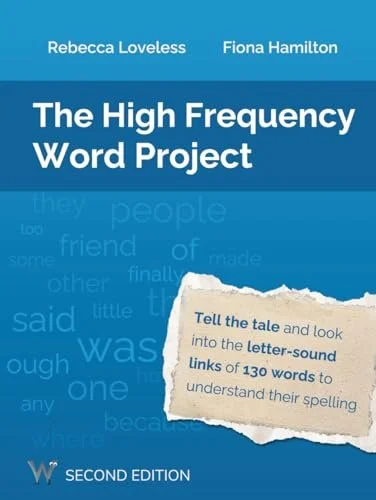
The High Frequency Word Project
by Rebecca Loveless and Fiona Hamilton
This book is a mine of information for those teaching how to spell high-frequency words
The High Frequency Word Project gives the information and basic resources for teachers to implement a programme for teaching high-frequency words.
High frequency words can be particularly challenging to spell in English because they often have atypical links between letters and sounds e.g. through, said, once. The key idea of this book is that explaining the structure and etymology of these words will help pupils to understand and remember them better.
“We find that sharing word stories is one of the most powerful ways to both strengthen vocabulary and ignite students’ curiosity and passion for language learning.” (p. 15)
How it’s organised
An introductory section explains what high-frequency words are, and outlines the main concepts and terminology used throughout the book.
The main part of the book is list of high frequency words in alphabetical order, with approximately one page devoted to each word. Each page is designed to include the information that teachers need in order to teach that word. This information includes:
Sample sentences and phrases that exemplify different usages of the word
A ‘Tell the Tale’ section, which gives the etymology of the word as short story that the teacher can read aloud or adapt
‘Find the Family’, which lists words from the same morphological family (that is, sharing the same base)
‘Connect to the Cousins’, which lists words that are etymologically related but not from the same morphological family
‘Foils’, which share certain letter sequences with the keyword, but are not related
‘Look into the letters’, which analyses the graphemes in the word, and, where relevant, gives a word sum that shows the morphological structure of the word.
A final section includes some printable worksheets, assessment and progress-monitoring resources, and guidance for structuring lessons.
The best bit
The best thing about the this book is undoubtedly the meticulously researched ‘tales’ for each high-frequency word. These descriptions are written so as to be easy to follow, but they are not over-simplified.
To have all this information collated in one place is incredibly useful for teachers, who are unlikely to have the time – or possibly the expertise – to research these stories for themselves. The stories include details of the language of origin, and then track changes in the spelling and meaning of the word over time.
Some of the stories are particularly illuminating. For example, I had no idea that the <-end> in friend was from an old suffix that indicated someone who does something – people used to say helpend for helper. And the <fri> in friend shows its connection to the Norse goddess of love and marriage, Frigg. (Friday is also named after Frigg.)
I also found the explanation of the relationship between go and went very clear. In Old English, go and went were originally in separate word families, with the past tense of go being eode or gaed. But, over time, went became more popular. Went is the past tense of wend (as in “to wend your way through the crowd”). Due to their similarity in meaning, go and went now belong to what the authors call a ‘blended family’, with went acting as the past tense of go!
Who is it for?
The book is aimed at primary teachers who are trying to familiarise their pupils with high-frequency words, at the same time as teaching them many of the principles of English spelling. There are accompanying worksheet resources that can be purchased too.
I’d also recommend it as an (admittedly rather pricey) etymological dictionary for any literacy teachers who have to teach high-frequency words, even if you aren’t interested in implementing the whole programme.
Podcast pairing
To find out more, listen to this episode of the For The Love of Literacy podcast, in which Rebecca Loveless and Fiona Hamilton are interviewed about the project.
Other useful resources
If you’re interested in The High Frequency Word Project, you may also like to take a look at the Spelling Strategies and Practice module from the LIfTT intervention. This module includes a pdf with 132 homework sheets, each based on one or two words that are ‘tricky’ for older children and teenagers. Each sheet includes a ‘Spelling information’ section that provides a simple explanation of the word’s spelling from an etymological, morphological or phonological perspective. This is followed by two or three short activities designed to engage students in thinking about key aspects of the spelling.