
Teaching Words and How They Work
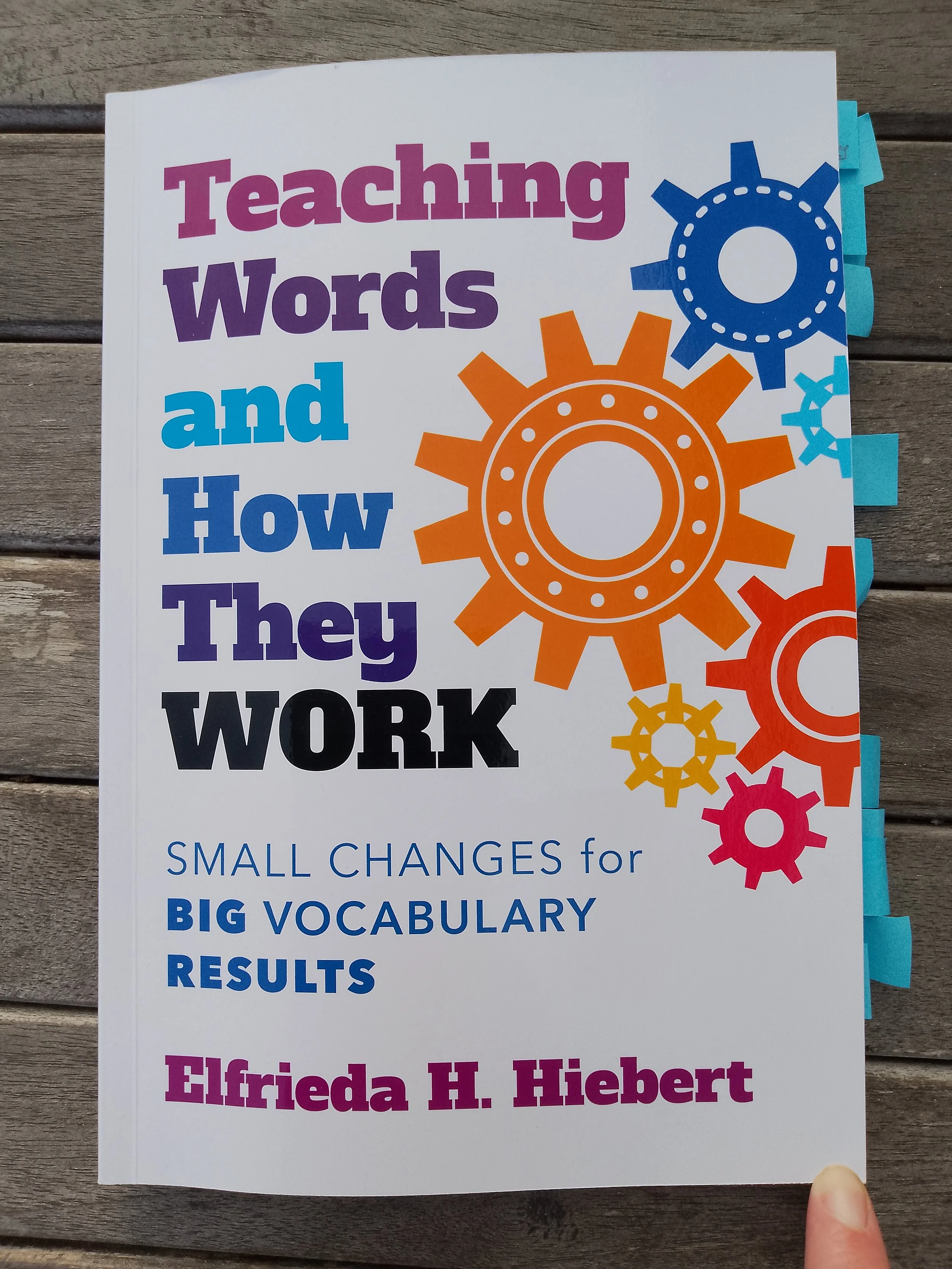
Teaching Words and How They Work: Small Changes for Big Vocabulary Results
by Elfrieda H. Hiebert
Expert insights into effective ways to teach vocabulary
Dr Elfrieda “Freddy” Hiebert is the founder of TextProject, a not-for-profit corporation that provides free resources to support teaching reading and vocabulary. Teaching Words and How They Work is a useful companion to the website, as well as an insightful read in itself.
What it’s about
A key theme of this book is that vocabulary can be taught effectively by focusing on the relationships between words, rather than teaching words individually. As the author notes, the conventional approach of teaching 6 to 8 words per week will result in only about 3,500 words being explicitly taught over a pupil’s school career, and “such instruction barely skims the surface of English vocabulary” (p. 3).
Hiebert also uses digital technology and text corpuses to inform teachers about the properties of words within different types of texts, and which words are most beneficial to teach to students.
Teaching words that are related morphologically and/or semantically
Rather than explicitly teaching a few individual words per week, Hiebert recommends teaching words in groups that share certain relationships. These might be words in the same morphological family such as melody, melodious, melodiously; or words that are grouped together within a semantic network – that is, they share aspects of meaning. For example, a semantic network based around music could include musical instruments (recorder, trumpet, cello, piano), and words to describe parts of music (melody, rhythm, chorus, notes), and words to describe how music makes people move (sway, tap, stomp, dance, clap).
Resources to support teaching through morphological families and semantic networks are available on TextProject.
Explaining ‘how words work’
Hiebert also emphasises that teachers should explain ‘how words work’ in terms of their etymology and structure. English words are borrowed from a huge range of languages, but, as explained in Chapter 4, there are three core layers, Anglo-Saxon, Romance (French/Latin), and Greek. The author explains how words with different origins will tend to have different properties. For example, words that derive from Greek tend to be used for scientific or technical concepts, and are often compounds with two equally-meaningful parts (e.g. arachno + phobia).
“Knowing how words are related in these three systems can support students when they encounter unknown words.” (p. 6)
Other important aspects of ‘how words work’ that Hiebert recommends teaching explicitly include:
homonyms, which are words that are spelled and pronounced the same, but have different meanings (e.g. duck, back, can)
complex phrases in which the meaning is not wholly transparent (e.g. place value, water table)
figurative language
collocations, which are words that are commonly used together (e.g. chocolate is often followed by bar, cake or chip).
These aspects of vocabulary, which Hiebert calls ‘recycling and remixing’, are described in Chapter 5.
Narrative and informational text types
Chapters 6 and 7 examine vocabulary in the context of different types of text, and discuss how features of these texts can impact teaching.
Chapter 6 discusses the vocabulary features that teachers may need to consider in narrative texts, such as archaic vocabulary, deliberate use of synonyms, and interjections, onomatopoeia and abbreviations.
While Chapter 7 considers informational texts. In informational texts, the use of synonyms is less common, and repetition of keywords is more frequent. The precise meaning of words or phrases is critical, and the way words are interrelated conceptually is important.
Text complexity
Chapter 8, on text complexity, provides an accessible explanation of the most common systems for grading text complexity in the US: Guided Reading Levels, and the Lexile Framework. In particular, Hiebert emphasises that “neither Lexiles nor GRLs offer specific information on challenging vocabulary” (p. 105), and states that:
“Vocabulary is the most critical variable in determining comprehension and in increasing students’ capacity to understand increasingly more challenging texts. When a text complexity system does not give information on the vocabulary demands of texts, teachers are stymied in their efforts to increase students’ vocabulary prowess.”(p. 106)
Rather than using text complexity ratings as means to organise vocabulary teaching, Hiebert suggests that clustering texts by topics can support the learning of shared words from text-to-text, and develop topic expertise.
Implementation
Each chapter ends with short case study. These case studies are organised around ‘the 4Cs’ – Conversations, Collections of words, Core reading, and Choice reading. Each of these represents an avenue by which teachers might choose to implement the recommendations in the chapter, often using the TextProject resources. The case studies are interesting and varied, although, for me, they also highlighted the amount of effort involved in planning effective vocabulary teaching!
Who is it for?
I’d recommend Teaching Words and How They Work to primary teachers who are keen to teach vocabulary more effectively. The rationale behind grouping words morphologically and semantically is well-explained, and there are tips for how to teach vocabulary in the context of texts and topics. The guidance about implementation in the book is not in-depth, but the TextProject website has useful resources for putting the recommendations into practice. The case studies are less relevant to secondary teachers, although there are still valuable lessons that secondary teachers can learn from the general approach.
Podcast pairing
On this episode of the For the Love of Literacy podcast, Freddy Hiebert discusses effective ways to teach vocabulary using the approaches described in Teaching Words and How They Work.
I’d also recommend Sean Morrisey’s episode from the same podcast series, which discusses how he has implemented vocabulary teaching inspired by Freddy Hiebert’s approaches, alongside other influences.
For a literacy intervention that teaches reading and spelling alongside challenging vocabulary, take a look at LIfTT.