New Words, New Meanings
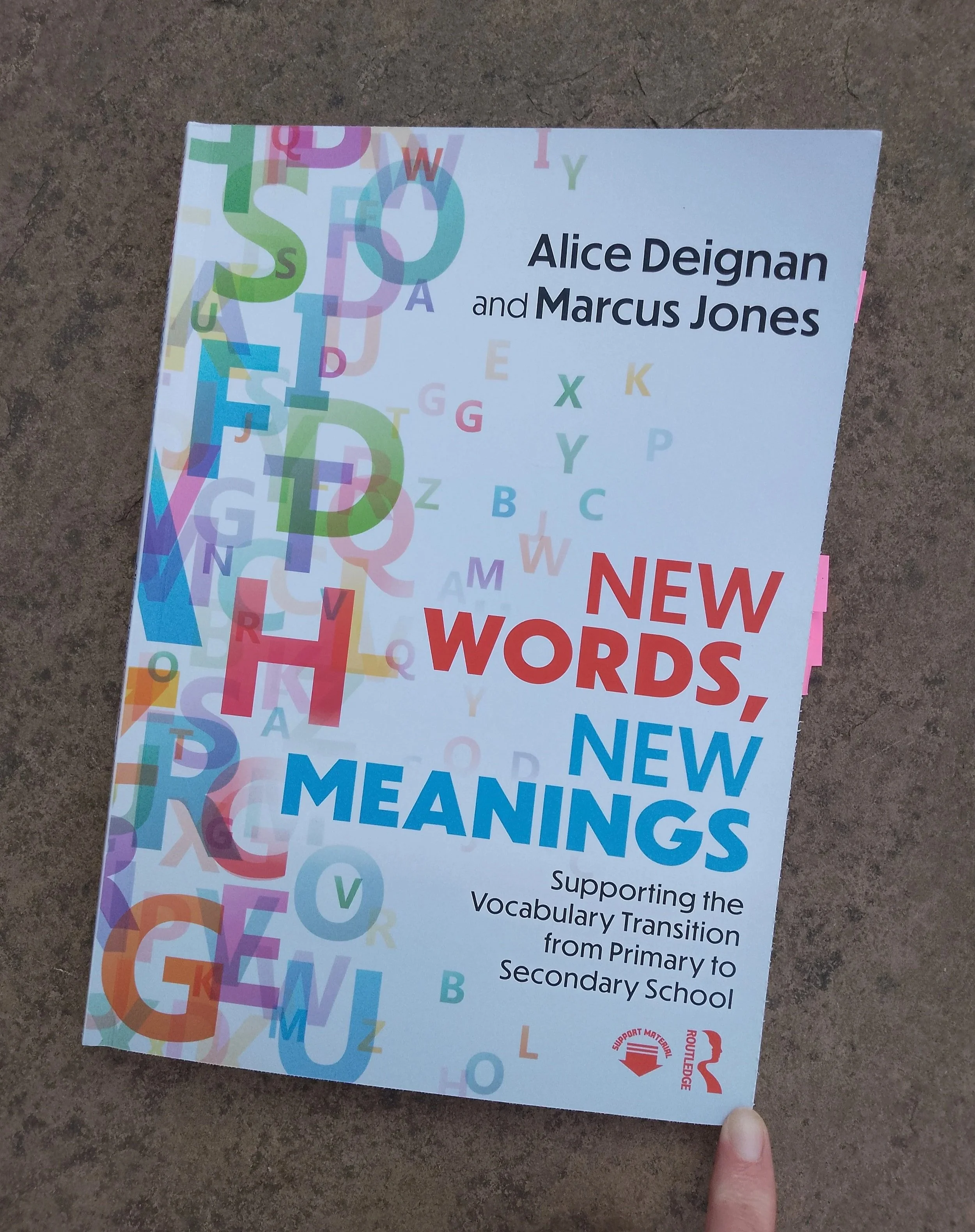
New Words, New Meanings: Supporting the Vocabulary Transition from Primary to Secondary School
by Alice Deignan and Marcus Jones
A thorough analysis of the differences in vocabulary that students encounter between primary and secondary school
What it’s about
New Words, New Meanings is based on the findings of a research project looking at differences in vocabulary at the transition between primary and secondary school. By highlighting these differences, the authors aim to give teachers useful information to support students in bridging the gap.
In the first six chapters, Professor Alice Deignan describes how data was gathered from primary and secondary schools in northern England to create a corpus of spoken and written language that students are exposed to at school. She discusses the findings, and also the implications for the difficulties that students may encounter with vocabulary.
Chapters 7 and 8, written by Marcus Jones, a secondary English teacher and literacy lead, put the findings in a practical context. He offers guidance to teachers on how to select and teach vocabulary words in the classroom, and also looks at how support for vocabulary across the transition might be implemented at a more strategic level.
What are the key differences between vocabulary at Key Stage 2 and Key Stage 3?
The researchers looked specifically at Maths, English, History, Geography and Science, comparing vocabulary from Years 5 and 6 with vocabulary from Years 7 and 8. Data was collected from spoken language (recordings of teachers during lessons) and written texts (presentations, worksheets, reading extracts, textbooks, assessments).
Teachers can read about the detailed findings in the book, which includes helpful lists of words that are common in Key Stage 2 (KS2) but not Key Stage 3 (KS3), and vice versa for each subject. But these were my main takeaways:
KS2 words tend to be more concrete, and are often nouns that relate to a specific topic (e.g. dam, Nile, pharaoh, colliery).
KS3 words tend to be more abstract, and reflect broader themes and general patterns (e.g. evidence, freedom, population, decline).
In English, the SATs have a big impact on the language used in KS2, with top words including pronoun, parenthesis, subordinate and conjunction. In contrast, in KS3, the words reflect an emphasis on literature (e.g. Gothic, tone, technique, audience).
In Science, vocabulary reflects a narrative-based approach to discoveries and inventions in KS2, contrasting with a focus on scientific concepts and processes in KS3.
What are the main difficulties that students may encounter with vocabulary at the transition to secondary?
The authors emphasise that words with multiple meanings, also called polysemous words, can cause significant difficulty for students.
“What we found was that polysemy is incredibly frequent across all subjects that we looked at.” (p. 73)
To make things even trickier, a polysemous word might have not only a different meaning from its everyday usage, but also a different meaning across different academic subjects. For example, concentration has a different everyday meaning (e.g. I lost concentration for a moment) from its meaning in Science (e.g. high concentration), and its meaning in History (e.g. concentration camp).
Polysemous words are particularly difficult to tackle because students often think they know the meaning of a word because it looks familiar, but actually they may not know the specific meaning that was intended in this academic context. For this reason, words that students ‘half-know’ can cause more difficulties than words that are entirely new!
Collocations, which are words that frequently occur together, can also cause difficulties at KS3. This is because collocations in secondary subjects are often different from collocations in everyday conversation. For example, store would usually be used before words such as department, furniture or grocery, but in KS3 Science, one of the words most often used alongside store is energy, and energy store has its own technical meaning. The authors explain why this can cause problems:
“When we are listening or reading, our knowledge of collocation helps us to predict what is coming next. All of this helps us to speak and write, read and listen far more quickly than we could if we had to process each individual word separately. However… if a text has collocations that are not familiar to us, we’re likely to struggle to read it at a normal speed because we can’t use the usual strategy of predicting what is coming.” (pp.85–86)
How can teachers support students’ vocabulary in the transition from primary to secondary?
Like Teaching Words and How They Work (reviewed here), New Words, New Meanings recommends explicit teaching of polysemous words and collocations.
The authors also warn against too much encouragement of students to rely on context to figure out the meaning of unknown words. Although a word’s meaning may seem obvious from the context if you already know it, the researchers’ interviews with pupils showed that they often had difficulty figuring out meanings accurately from context – there is rarely enough information to glean a precise definition (see p. 87).
Other recommendations include using multiple examples, introducing words using the Frayer model, building a culture of curiosity about vocabulary, checking for understanding, and more.
The best bit
Sometimes pupils can feel that their usual way of speaking is denigrated if they are encouraged to speak and write differently in class, so I was pleased that the authors emphasise that advanced vocabulary is not intrinsically ‘better’ than other words. Rather, it’s a matter of ‘register’ – using the language that is appropriate for the social setting (e.g. job interview vs football match), the medium of communication (e.g. face-to-face conversation vs writing a letter), and the topic (e.g. astronomy vs gymnastics).
“We think all children need access to academic registers to support their learning, and in an ideal world, this should be without any notion that one register is ‘better’ than another – just more fit for a particular purpose.” (p. 28)
The less good
Although morphology and etymology were mentioned, I didn’t feel that they were given sufficient emphasis as effective tools for teaching vocabulary. The effectiveness of integrating spelling with vocabulary teaching was also not explored.
Who is this book for?
New Words, New Meanings is likely to interest KS3 teachers, who may not be aware of the changes in vocabulary that their students are facing at the transition from primary to secondary. However, although I think this book does a great job of highlighting the issues that students face, readers may find the tips for implementation are fairly general.
For teachers outside England, it’s worth being aware that the vocabulary within the corpuses reflects England’s National Curriculum, and, particularly in History and Geography, the specific topics that were being taught at the participating schools. Nevertheless, the general principles are likely to be relevant to any educators teaching students within these age groups.
If you’re interested in training for secondary teachers on effective strategies for teaching vocabulary, click below!