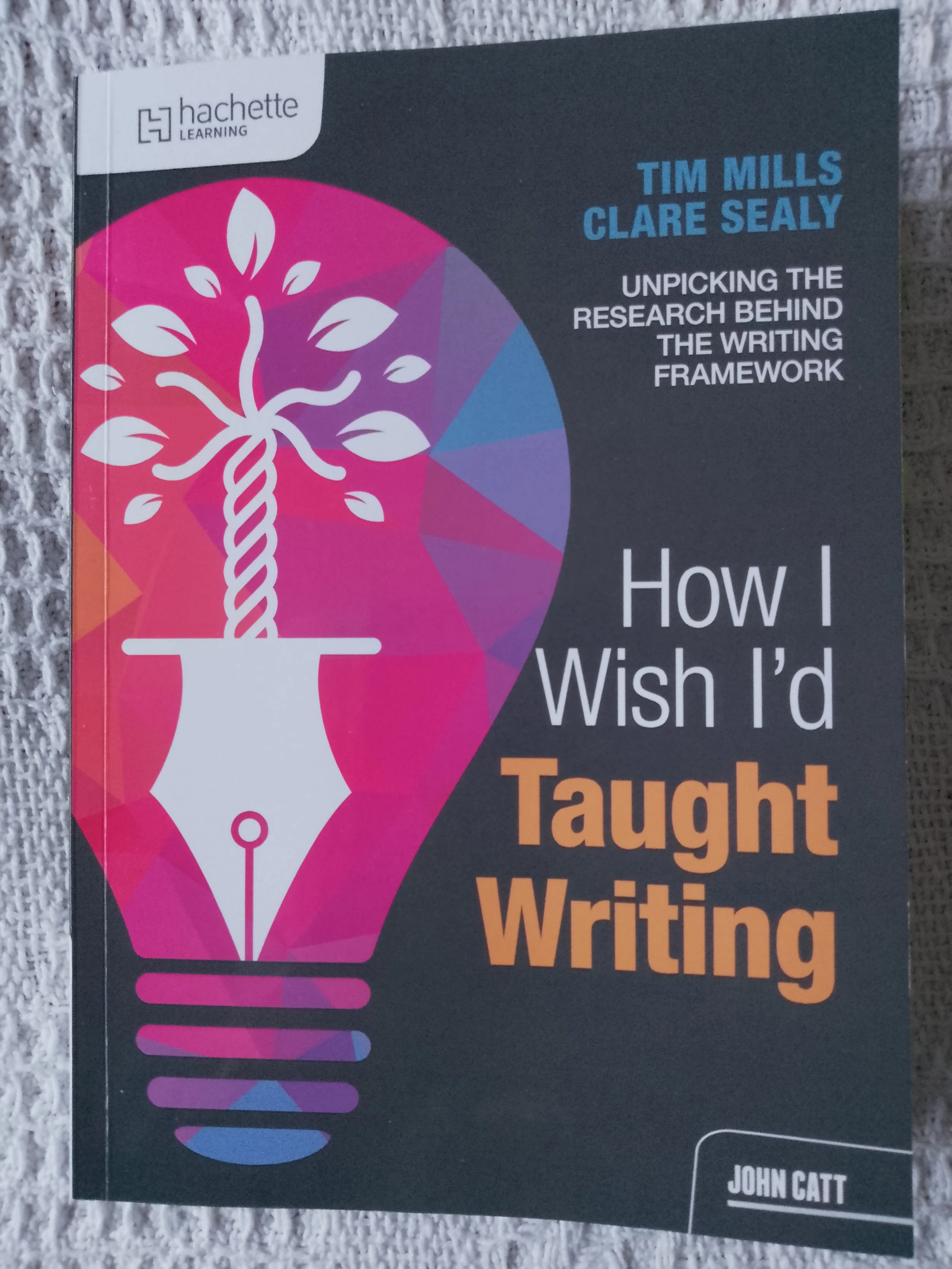
How I Wish I’d Taught Writing
by Tim Mills and Clare Sealy
Concise yet detailed guide to teaching writing, bringing together research and practice
How I Wish I’d Taught Writing explains how research can inform how we teach writing. It covers a huge range of topics, from handwriting and spelling, through sentence structure and composition, to motivation and assessment. The authors, Dr Tim Mills and Clare Sealy, are former classroom teachers and school leaders, both of whom were involved in creating the Department for Education’s Writing Framework. Describing their teaching experiences – both positive and negative – enlivens the book, gives their advice authenticity, and reassures educators that it’s OK to learn from mistakes.
In this relatively short review, I’m unable to do justice to the wide range of topics that are covered, so I’ve just focused on some key ideas.
The limits of working memory
A theme throughout the book is awareness of the limitations of working memory. Working memory refers to the ‘brain’s workspace’ (p. 19), and it has a limited capacity – we can’t think about too many things at once. Fortunately, we can overcome the limits of working memory by automatising certain processes so that we can do them without having to think about them.
Writing is a complex process, making it particularly vulnerable to working memory overload. Many chapters within the book concern how to automatise sub-parts of the writing process, to free up working memory capacity for deciding what to write.
Transcription
It was pleasing to see a book on writing going right back to the basics, and Chapter 3 on ‘Transcription’ focuses on handwriting and spelling.
Handwriting
The authors emphasise the importance of developing automatised handwriting to enable fluent writing. The section on handwriting includes a description of the motor control skills that are required for writing, and how these might be developed by Early Years staff. Another key point is that students need to internalise both the movement pattern involved in forming a letter and the visual shape the letter makes.
The authors also comment on the positive effects of teaching handwriting and phonics together (p. 35):
‘When linked to phonics instruction, handwriting can be taught from the very beginning of Reception. Not only does this ensure a purpose and motivation for children, but the understanding of the alphabetic principle – that the letters they are forming are representations of the sounds of the language – supports the link between the sounds and the letters and helps children form a mental representation of the letter rather than merely copying the letter. It also means that the handwriting/grapheme formation aspect of phonics can be taught in very small steps with lots of practice.’
Yet they also point out that most phonics programmes are designed so that the order of teaching of graphemes is logical from the perspective of decoding, but not logical in terms of ease of letter formation. This observation made me curious to know whether designers of phonics programmes take ease of letter formation into account!
Writing position, grips and joins are also briefly covered.
Spelling
Again, the importance of spelling is emphasised in the context of working memory limitations: poor spelling will limit writing fluency. The authors also mention Charles Perfetti’s work suggesting that accurate spelling feeds into reading proficiency.
They advocate explicit teaching of spelling through phonics, but acknowledge that ‘the correspondence between the grapheme and the phoneme is enough to read but not enough to spell’ (p. 43). So, explicit teaching of the allowable sequences of letters in English may be needed.
They also recommending using morphology to support spelling, which I welcome. Unfortunately, their example states that uncomfortable has three morphemes: <un-> <comfort> and <-able>. In fact, comfort can be further analysed into the prefix <com-> and the base/root <fort>, meaning ‘strength/strong’. Fort is the trickiest syllable to spell in this word because we tend to reduce it when we speak, so the analysis ‘un + com + fort + able’ is particularly helpful for spelling. For me, this error highlights the need for morphology training for teachers. Nevertheless, it’s good to see the value of morphology being recognised.
Etymology is also included in this section, alongside mention of its benefits for vocabulary development. However, the authors comment that ‘The research into the usefulness of etymology instruction for spelling improvements is fairly thin, and what there is suggests that it is only effective for children in upper primary who read and write well.’ I’d be interested to know the research on which this conclusion is based, as I suspect that the usefulness of etymology for spelling is very word-dependent. I would expect it to be most effective for words with letters that are unexpected but have a clear etymological explanation e.g. <w> in two, <b> in debt.
Grammar and sentences
Chapter 6 gets into the detail of how teach students to write complex sentence structures with confidence. Again, the idea is that by practising different sentence structures until they are confident, students will be able to incorporate these structures in their own writing without overloading working memory.
The authors give lots examples of different activities that promote using various features of sentences such as coordinating conjunctions, subordinating conjunctions, relative clauses, adverbials and appositives. They are particularly keen on sentence combining tasks, which they suggest can be done orally even as young as Reception, used as starters in English lessons, and can be made more challenging as pupils develop their sentence construction skills.
However, the authors point out that it’s important not to overemphasise the technicalities of grammar (p. 106):
‘Using the terms relative clause, adverbial or appositive provide a useful shorthand, but accurate identification of one kind of subordinate clause rather than another is not the main point here. The main point is that pupils have internalised a range of different ways of making their writing clearer and more interesting. That’s the whole point of the enterprise. Using technical terms when teaching avoids the need to continually resort to unwieldy explanations – so they are useful. But it is understanding function that is key.’
Composition
Chapter 7 on ‘Composition’ applies the step-by-step approach to the bigger picture of writing a longer text. This chapter discusses how to teach planning, drafting, revising and editing. It includes a lot of ideas and suggestions – I found the ‘key messages’ section that ends each chapter particularly helpful here!
A key point that I took from this chapter is using model texts from different genres – if you expect pupils to write a particular type of text, they need to have seen examples and analysed the structure and the language features.
Examples of planning models to support different kinds of writing are provided. The process of revising a text is also discussed, including how to make peer and teacher feedback effective, and the use of evaluation criteria against which pupils can assess and revise their own writing.
Favourite quote: AI and the importance of writing
This book begins with a chapter on ‘Why writing matters’. I liked the authors clarity on the importance of writing for developing the ability to think (p. 11):
‘Writing not only demands thinking but is also a means for thinking… This is why AI must not replace learning to write in schools. If writing is outsourced to AI, so too is the thinking. Schools are nothing if they are not places that develop children as thinkers.’
Who is it for?
I’d recommend this book to any educators from early primary to the end of secondary who teach writing. The wide range of topics covered means that each individual teacher may only find certain topics directly relevant to their teaching practice. Nevertheless, it’s valuable to see how each piece fits into the bigger picture of a pupil’s writing journey, and to realise how important it is to build automaticity at each stage. A thorough understanding of different steps in the writing process is also very helpful when trying to pinpoint pupils’ writing difficulties.
Click here to take a look at the Punctuation and Sentence Writing module from LIfTT, the Literacy Intervention for Teens and Tweens.