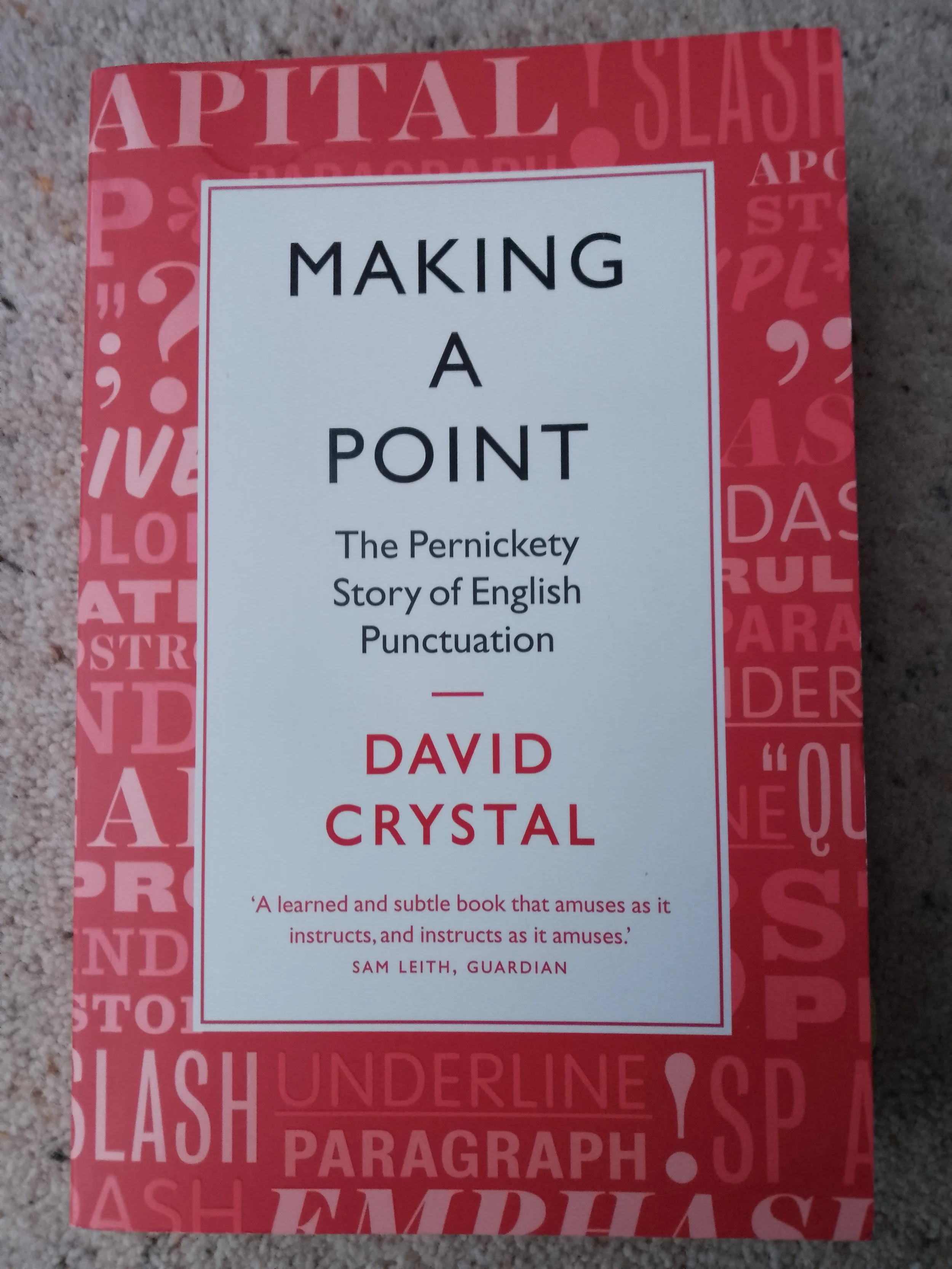
Making a Point: The Pernickety Story of English Punctuation
by David Crystal
An excellent introduction to the history of punctuation in English, offering a pragmatic rather than a prescriptive approach.
Making a Point, published in 2016 by Profile Books, is part of Professor David Crystal’s excellent introductory series to different aspects of the English language, all of which I would recommend to teachers who want a solid grounding in how the English language works (Spell It Out is reviewed here).
The history of punctuation in English
The first 13 chapters are a brief history of punctuation in English, from the introduction of conventions as basic as spaces between words to the (more or less) standardised punctuation marks used in publications today.
David Crystal describes how old manuscripts frequently marked the major structural divisions of a text, such as chapters or paragraphs, by large decorative letters or by indenting or outdenting the first line of section. But, within large blocks of writing, there was little punctuation. As the author says (p. 15):
‘Punctuation … was as much a job of the reader as the writer.’
He explores how the role of punctuation evolved as the nature of texts and their readers changed. In the Anglo-Saxon period, texts were primarily religious, were often transcribed by monks, and were usually written with the purpose of being read aloud. During the Middle Ages, texts served a much wider range of functions, and might have been written by notaries, clerks, teachers and creative writers, who combined punctuation marks from different systems in a diverse range of ways. The arrival of the printing press marked the beginning of a move towards standardisation, but it was a very gradual process.
Tensions in usage
Within the first 13 chapters, David Crystal also introduces the two key tensions that underlie most disagreements about the appropriate use of punctuation:
Should punctuation be viewed from a phonetic or a grammatical point of view? That is, should punctuation provide guidance about how to read aloud a text, or should it reflect the grammatical structures within a sentence?
He uses the following sentence to illustrate this (p. 28):
‘Of particular importance in developing a new system is the need to provide a network of supporting agencies.’
From a phonetic point of view, a speaker would be likely to mark the end of the subject (after ‘system’) with a short pause and a change in pitch, which could be marked by a comma. However, from a grammatical point of view, the Modern English convention is that the link between a subject and the rest of the sentence is so close that it shouldn’t be disrupted by inserting a comma.
Should a semantic or a pragmatic approach to punctuation be prioritised? The author explains this as follows:
‘Our choice of punctuation is going to be chiefly guided by semantic or pragmatic considerations. Normally, it will be semantics: we will aim to make our meaning clear to the reader. But there are occasions when pragmatic factors take precedence: we can decide to use a mark, or not use a mark, because it looks beautiful/ugly, because it’s easier/more difficult to write/type/text, because it’s available/unavailable in a certain font, because is takes up more/less space on a page, or simply because we were taught that way.’
Fashions can also affect our choices – the style nowadays is generally for an uncluttered look. And the context is also important – is it formal writing or a text message?
I appreciated the clear elucidation of these tensions to illustrate that there isn’t always a ‘right’ answer to what punctuation is appropriate. As with so many things, the answer might well be “it depends”!
Top to bottom through the hierarchy of punctuation
In Chapters 14 to 31, David Crystal explores the ‘hierarchy’ of punctuation from top to bottom, with each chapter focusing on a specific type of punctuation. He guides us through how text is organised: at the highest level, into sections; through paragraphs, sentences and clauses; down to word-level punctuation such as apostrophes and hyphens. At each level, there is a brief historical perspective and an overview of the function of the relevant punctuation marks in present-day English. I particularly like the way he illustrates the impact of punctuation with numerous well-chosen examples that show how punctuation marks can change meaning in subtle and nuanced ways.
The author also examines factors which influence our choice of punctuation. For instance, the same syntactic construction might be punctuated differently depending on semantic factors such as the speed of the action. He points out that we are more likely to include a comma after an initial adverbial when the action is slow than when the action or the emotion speeds up (p. 245):
Gradually, the first light of dawn illuminated the room.
Outside, several children were playing.
vs
Suddenly the dog barked.
Obviously I’ll go with you.
Therefore, following a hard-and-fast grammatical rule may not always produce the most impact. Or, as David Crystal puts it succintly, adapting Kurt Vonnegut (p. 202):
‘Rules only take us so far. That should be the motto for any work on punctuation.’
A wider look at punctuation
The final chapters take a wider look at punctuation, investigating its interface with graphic design, and the influence of the internet and social media, including a brief exploration of emoticons.
As usual with this introductory series, David Crystal concludes with a short section on teaching. His emphasises that students should learn that punctuation marks are part of a hierarchical system, and that punctuation should be taught in context (p. 352):
‘Try to avoid the trap of ‘having a lesson on punctuation’, without some other motivation. That should never be the routine, for punctuation is never an end in itself. It’s always in the service of some other aspect of language.’
The best bit
I really liked the pragmatism that is evident throughout the book. Rather than looking for ‘the right’ way to use punctuation, David Crystal explores how it is used in practice – he looks at how punctuation usage has changed and continues to change.
A neat example of the continuing evolution of punctuation is the impact of texting on our interpretation of full stops. As people stopped using full stops at the end of short texts (for reasons of time, effort and limited characters), the use of a full stop in a chat message became a positive decision rather than a neutral way of ending a sentence. Therefore, nowadays it is often perceived as indicating abruptness or anger. Contrast the following responses:
we could do that [sure, that’s fine]
we could do that. [but I don’t really want to]
Who is it for?
As it is introductory rather than technical, Making a Point is accessible for a wide audience. I’d recommend it to readers who are interested in a pragmatic rather than a prescriptive approach to punctuation. It successfully combines a history of punctuation with an easy-to-read guide to how punctuation is used in practice.
Click here to take a look at the Punctuation and Sentence Writing module from LIfTT, the Literacy Intervention for Teens and Tweens.