
LIfTT Version 2: What’s new?
Why is a new version of LIfTT needed?
I’m always looking for ways to improve my teaching – always analysing what works well, and what could be better. So, naturally, my resources and teaching practice evolve over time. Developing the Literacy Intervention for Teens and Tweens (LIfTT) has been an iterative process driven by feedback from colleagues and customers, professional development, new research, and, of course, using the resources myself!
Earlier this year, I decided the time had come to create a new edition of LIfTT. So I’m pleased to say that (somewhat later than anticipated) Version 2 is now available!
What’s new?
At the heart of the new version of LIfTT is closer integration of morphology with other elements of literacy. But I’ve made other changes too. Click the links below to find out more…
Section 1. Improved integration of morphology within the phonics and etymology modules
Section 2. Adopting the ‘box the base’ notation for analysing the structure of words
Section 3. Removing the term ‘split digraph’, and teaching Final Silent <e> as a marker of long vowels
Section 4. Using the International Phonetic Alphabet
Section 5. Improved ease-of-use for teaching LIfTT to students from different accent backgrounds
Section 6. General editing for clarity
1. Improved integration of morphology within the phonics and etymology modules
In the new version of LIfTT, I wanted to make it even easier to teach morphology alongside phonics and etymology. To that end, I’ve incorporated extra morphology worksheets within the phonics and etymology modules.
The extra worksheets in the phonics modules use morphological matrices that feature a base that includes the target grapheme, as shown below.
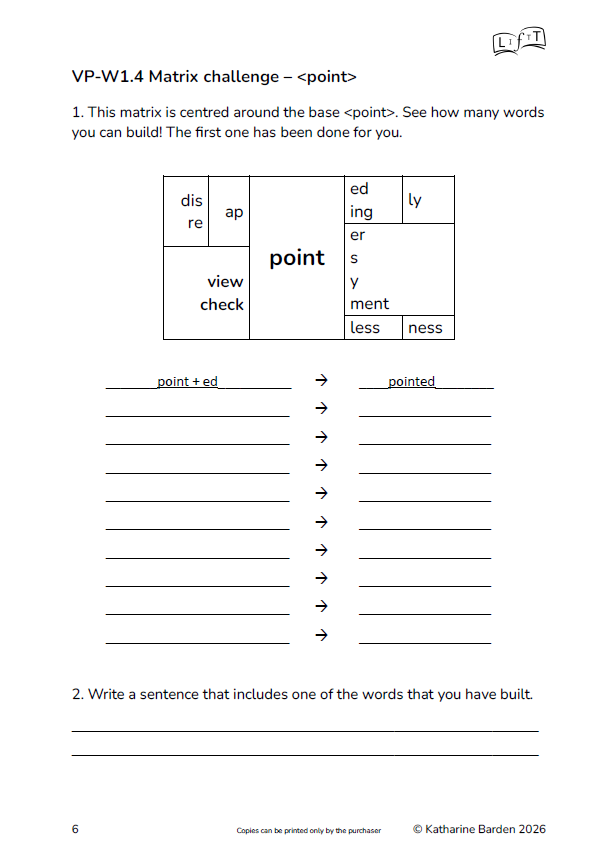
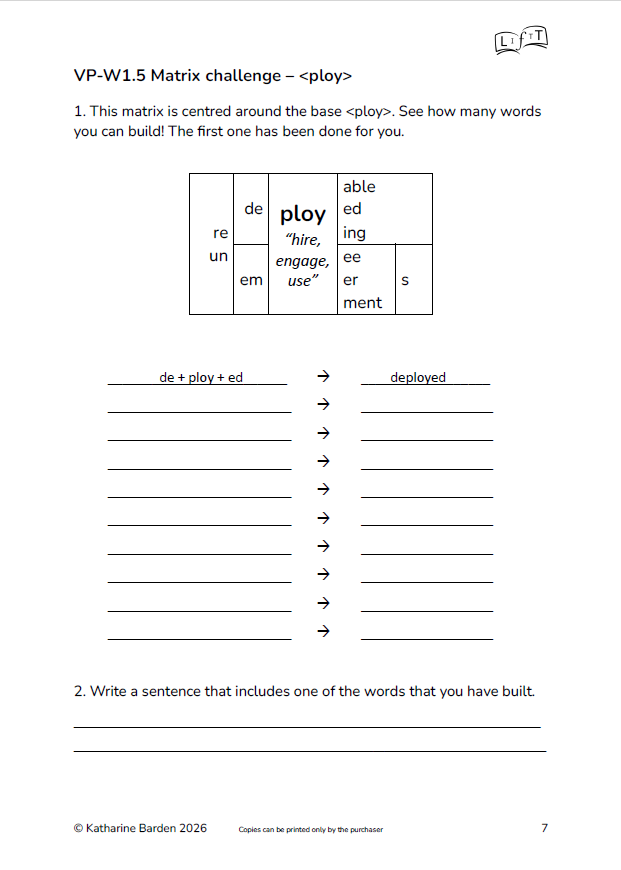
When studying the graphemes <oi> and <oy>, students can build words using matrices centred on <point> and <ploy> (see first two panels).
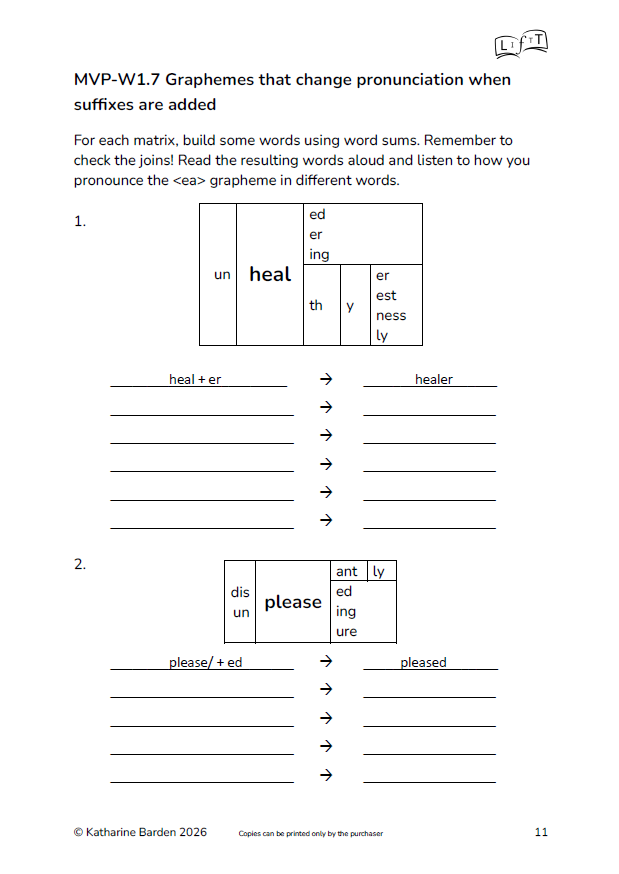
Matrices can also help students to understand that the same grapheme can be pronounced in different ways, even within the same base. For example, contrast the pronunciation of <ea> in heal vs healthy (see third panel).
Within the etymology modules, I’ve added worksheets that use morphological matrices with bases deriving from Greek and Latin (see the examples below).
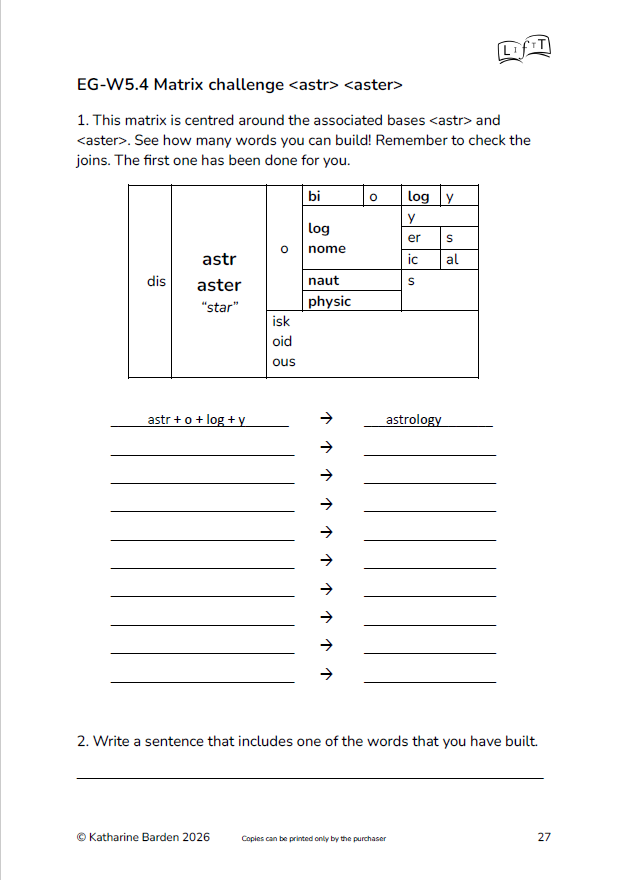
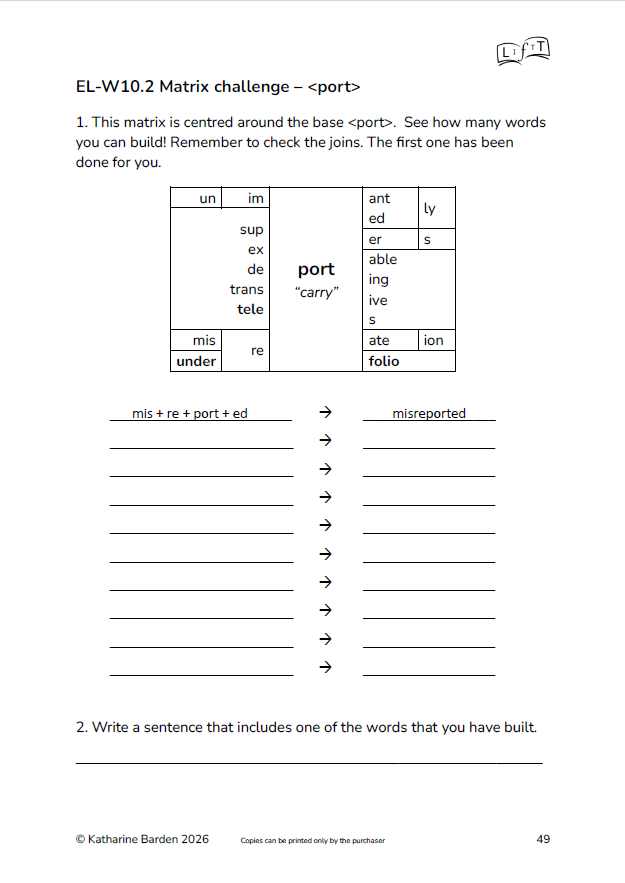
Matrices based on <astr> and its associated base <aster> (panel 1) and on <port> (panel 2) allow students to build advanced words that use the target base.
I had two main reasons for wanting to integrate morphology more closely with the other areas of literacy:
Version 1 of LIfTT included morphological matrices for topics that directly addressed the structure of words, such as learning about free and bound bases, or learning the suffixing conventions. I’ve been impressed by how quickly students ‘take to’ morphological matrices, and how easy it is to use matrices as a springboard for discussions that make meaningful connections between words. Therefore, I was keen to include more matrices in Version 2 for teachers to ‘dip into’ as convenient to support students with learning particular graphemes (in the phonics modules) or bases (in the etymology modules).
LIfTT is designed to work in ‘strands’, so that teachers can customise the intervention by teaching several modules from different strands concurrently, to suit their student’s needs. For example, there is a ‘word study’ strand, a phonics strand, an etymology strand and more, as shown in the LIfTT Intervention Plan below.
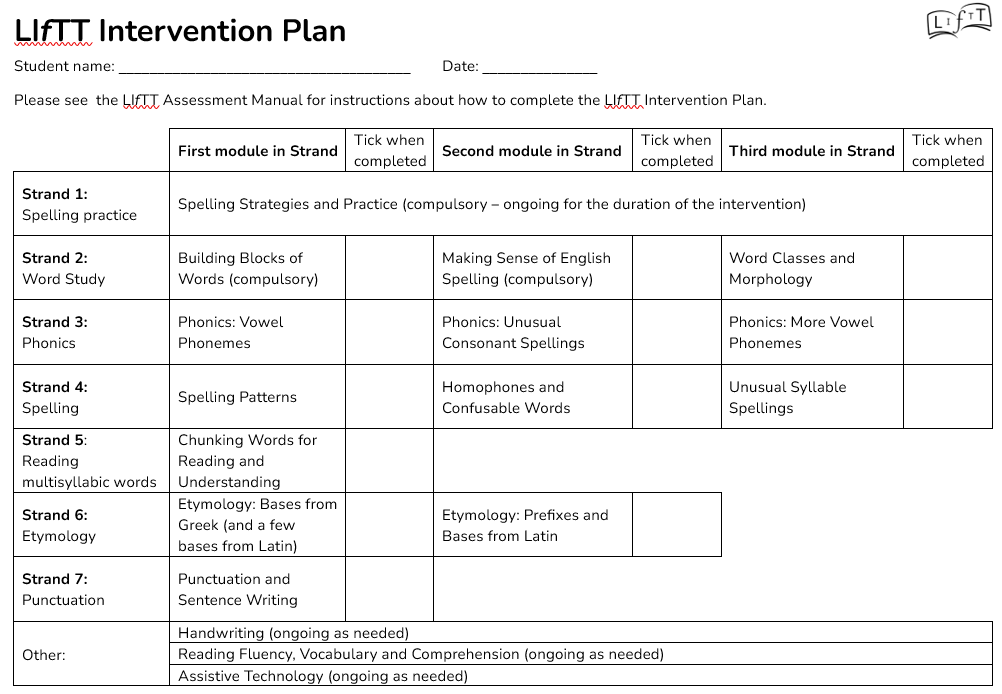
This blank LIfTT Intervention Plan shows the structure of LIfTT, which allows the teacher to pick modules from different strands to customise the intervention for their student(s).
In general, this organisational structure works very well. However, I found there was a subset of students who work particularly slowly for whom studying several modules concurrently was tricky. Their slow pace of working meant that it was hard to teach content from the phonics strand and the ‘word study’ strand successfully within a single lesson.
Now that I’ve added extra morphology worksheets within the phonics modules, it is much easier for these students to maintain a focus on morphology while also learning phonics.
Similarly, I added ‘matrix challenge’ worksheets to the modules on Greek and Latin etymology because I wanted to incorporate more opportunities for building advanced vocabulary, so that there was no chance of students forgetting their word-building skills.
2. Adopting the ‘box the base’ notation for analysing the structure of words
The new version of LIfTT teaches a different way of annotating the structure of words.
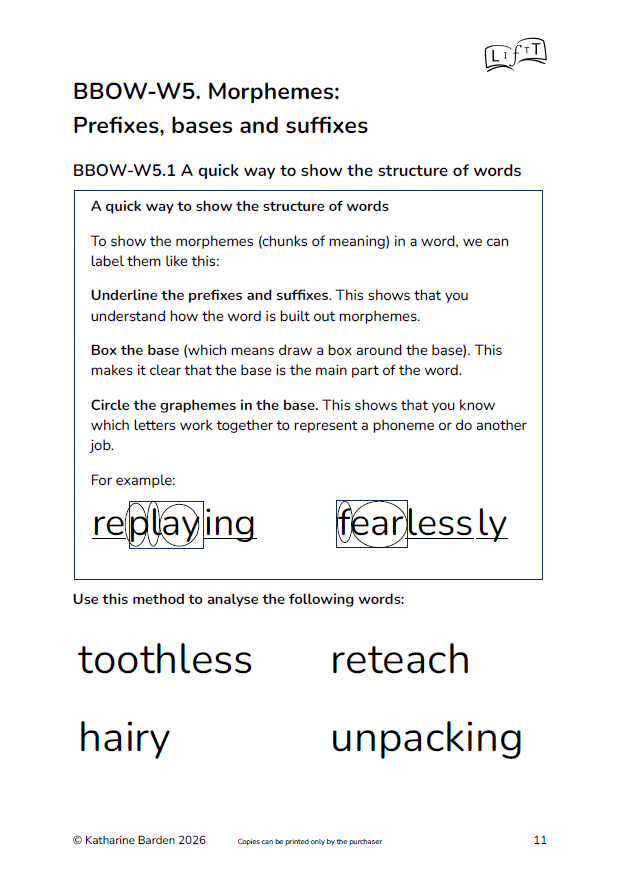
Previously, LIfTT used the ‘dot-and-dash’ approach to analysing graphemes within words, and encouraged students to circle affixes. However, after reading The High Frequency Word Project last year, I decided to adopt their method of underlining affixes, boxing the base, and circling graphemes.
As well as being satisfyingly alliterative, I love the way that ‘boxing the base’ makes it clear that the base is the most important part of the word in terms of meaning.
3. Removing the term ‘split digraph’ and teaching Final Silent <e> as a marker of long vowels
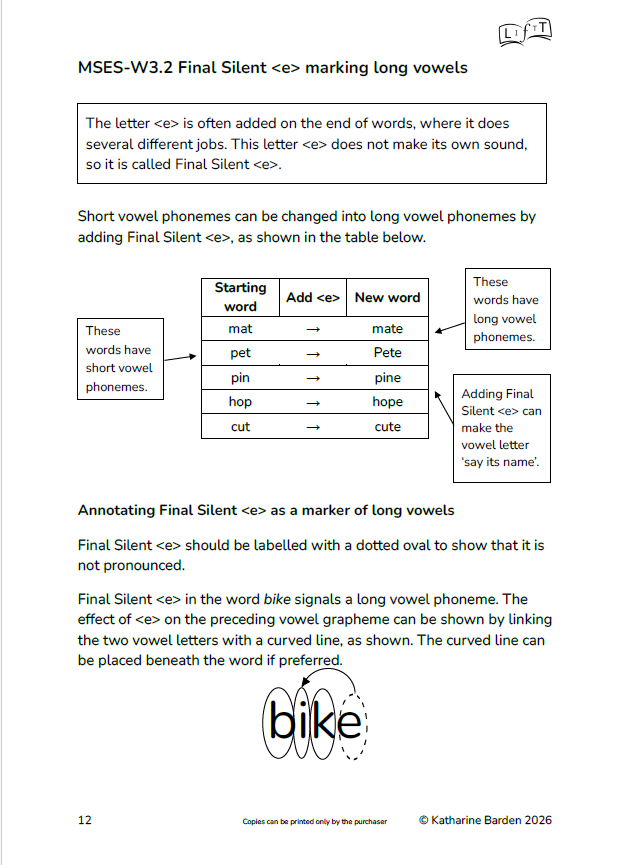
In Version 2 of LIfTT, I describe the <e> at the end of a words as Final Silent <e> in all instances when it doesn’t make its own sound. This includes instances of Final Silent <e> marking a long vowel sound (e.g. cake, pine, cute).
In the previous version of LIfTT, these spellings were referred to as ‘split digraphs’. I moved away from this term because I found it simpler to teach Final Silent <e> as a grapheme that performs certain functions, one of which is to mark long vowel sounds. In LIfTT Version 2, this function of Final Silent <e> is taught alongside other ‘jobs’ of <e> such as plural-cancelling (e.g. house), avoiding illegal letters (e.g. give), and more.
4. Using the International Phonetic Alphabet
Version 2 of LIfTT uses the International Phonetic Alphabet (IPA) rather than the simplified version that I used in Version 1.
With a background in phonetics, I’m comfortable using the IPA, but I was initially wary of demanding too much of teachers who may not have a background in literacy or linguistics, which is why I avoided it in Version 1.
However, I found that using the simplified version caused ambiguities when transcribing certain sequences of sounds. In addition, I realised that using the IPA will make LIfTT resources easier to integrate with other literacy resources that teachers may use. Essentially, using a common system of notation seems a good idea!
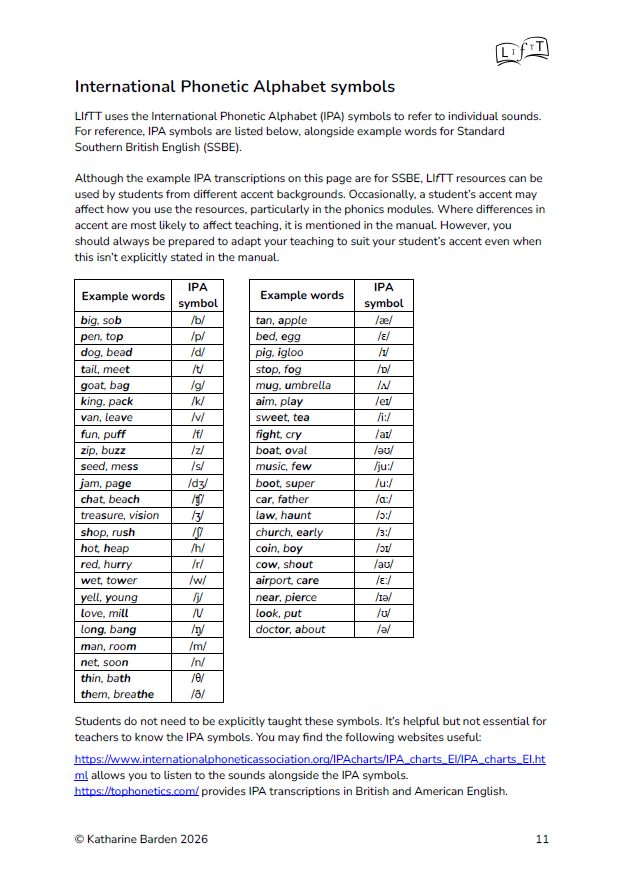
A guide to the IPA symbols is included in the Teaching Manual, and I’ve also include links to websites that are helpful to beginners.
5. Improved ease-of-use for teaching LIfTT to students from different accent backgrounds
I want to ensure that LIfTT is accessible to the widest possible range of students, including those from different accent backgrounds.
In Version 1, I included phoneme symbols on some of the student-facing resources, especially in the phonics modules. However, on reflection, I realised that by doing this, I was prescribing a ‘correct’ way of pronouncing certain graphemes. Therefore, Version 2 avoids using phonemes in a prescriptive way in worksheets and activities. For example, previously each worksheet in the Vowel Phonemes module included a symbol that specified the target phoneme; in Version 2, I’ve removed the phoneme symbols from most student worksheets, so teachers can easily adapt the resources to match how the student actually pronounces each grapheme in their accent.
In addition, the Teaching Manual now includes more explicit guidance about how resources can be adapted to suit different accents.
6. General editing for clarity
I’ve also edited LIfTT resources – especially the Teaching Manual – for clarity. The layout is improved, and increased use of subtitles and bullet points should promote ease-of-use.
And, with an intervention that runs to over 2500 pages, there were bound to be a few errors or typos, so I’ve amended as many of these as I could find!
Further information
To find out more about LIfTT, visit the intervention webpage, read a case study, or visit the shop to read a description of each module. In addition, An Introduction to LIfTT, a 28-page guide that describes the principles and structure of the intervention, is free to download here.
Contact me
If you have any questions about the new version of LIfTT, please get in touch. I’m happy to answer queries and receive feedback. If you’d like to arrange a call to discuss whether LIfTT is the right intervention for your student(s), contact me here.