The Illustrated Guide to Pedagogy
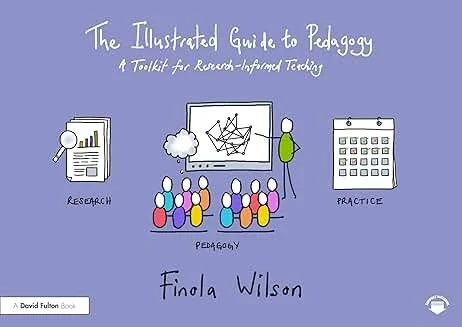
The Illustrated Guide to Pedagogy: A Toolkit for Research-Informed Teaching
by Finola Wilson
A practical and engaging book that explains how principles from cognitive science can be applied to teaching
There’s a plethora of recent books about the application of cognitive science to teaching, but The Illustrated Guide to Pedagogy is definitely a favourite of mine. Written by Finola Wilson, who is a consultant at Impact Wales and a former teacher, it focuses on the needs of teachers and explains how principles from cognitive science can help them. It is clearly, as stated in the introduction, “a book based on an understanding of the reality of teaching”.
What it’s about
The book is organised around fourteen principles of learning that summarise key findings from cognitive science research. The author practises what she preaches, and each principle is accompanied by pre-questions, specific examples (and often non-examples), and opportunities for practice.
As Finola Wilson explains each principle, she cites the research that it is based on – Sweller’s cognitive load theory, the ‘desirable difficulties’ supported by Elizabeth and Robert Bjork’s research, Ausubel’s research into the effects of the way information is structured, and much more. These explanations are accompanied by suggestions for how to apply the principles, for example how to design slides, different approaches to retrieval practice, how to sequence a curriculum, and how to set behavioural expectations in the classroom.
Some of this will be familiar to teachers who have started to explore research-informed teaching, but the author covers a wide range of material, so most readers are likely to find something new! For me, the work of Šed’ová and Sedláček (2023) on the importance of talking about learning was particularly thought-provoking.
The best bits
The illustrations (or ‘sketchnotes’) are the highlight of this book. The author has a knack for condensing the key points into an attractive, colourful graphic with her trademark ‘stick people’. The sketchnotes help the reader to understand the principles that she is discussing, and are also an easy reference to look back on and recall the main ideas. The illustrations also prevent the book from becoming overwhelming by breaking up the text and encouraging the reader to think about the ‘big picture’ for themselves.
The less good
A minor point, but I’m picky about layout, and some aspects of the text layout weren’t very appealing. The narrow left-hand margins were annoying, and the justified text in columns led to too much hyphenation across lines.
Who is it for?
I highly recommend this book for teachers or tutors who are interested in improving the impact of their teaching. The target audience is primarily classroom teachers, but most principles apply equally to anyone who is trying to help people learn.
Podcast pairing
To find out more about the The Illustrated Guide to Pedagogy, click the button below to listen to a special episode of the Impact Wales podcast. You can also click here for my review of the Impact Wales podcast!