Reading Development and Teaching
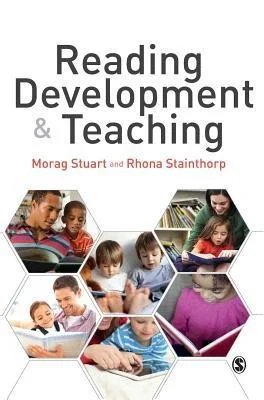
Reading Development & Teaching
by Morag Stuart and Rhona Stainthorp
An excellent textbook that introduces the main components of reading, and includes practical suggestions for teaching
Very clearly written yet with a friendly tone, Reading Development & Teaching is a fantastic introductory textbook. It combines information about the processes involved in reading and reading development alongside practical suggestions for teaching. For a relatively short book (199 pages, excluding references and indexes), it includes a surprising amount of detail.
What it’s about
The book is divided into four parts:
Part 1 introduces the terminology that is used to describe spoken language and writing systems.
This is followed by a thorough discussion of the Simple View of Reading (SVoR), the model proposed in 1986 by Gough and Tumner, that is a mainstay of teacher professional development. The SVoR describes reading as the product of two dimensions, visual word recognition processes and language comprehension processes. The authors not only describe the model, but also assess its validity, and introduce the components that make up the two dimensions of SVoR.
Part 2 explores the first dimension of SVoR, visual word recognition processes, in more depth. It focuses on two routes to recognising words – ‘phonological decoding’ (sounding out) and ‘lexical processes’, which refers to automatic recognition of words that have been seen before and stored.
Children’s development of the skills and knowledge for visual word recognition are described, including letter recognition and phonemic awareness. Then there’s a substantial chapter examining how to teach visual word recognition.
Part 3 moves onto the second dimension of SVoR, and is titled ‘Understanding spoken and written language’. The authors describe the main processes involved in language comprehension, and discuss evidence for how to support comprehension through vocabulary teaching, comprehension monitoring, summarisation and more.
Part 4 describes different kinds of assessment and their purposes, and clearly explains test statistics – standardised scores, percentile ranks, stanines and reading ages. The final two chapters look at supporting struggling readers, and how to help them with word recognition and comprehension difficulties.
The best bits
The best thing about this book is the clear and direct writing style. The authors describe research evidence that supports or contests specific teaching practices. They are careful to say when their suggestions go beyond what has been demonstrated to be effective, and into the realm of professional judgement. The graphics and tables are also very clear and informative.
The less good
Morphology and etymology form a big component of my own teaching practice, and have been the subject of an increasing number of recent research studies. However, etymology is barely mentioned, and morphology is covered only briefly, with a focus on what it is, rather than how to apply it in teaching. This edition was published in 2016, before morphology became more prominent in discussions of literacy, so this may be one of the few aspects of this book that have ‘dated’.
Who is it for?
I highly recommend this for anyone studying how to teach literacy, including early years and primary teachers, and also those learning to support struggling readers. It provides a short, clear introduction to the main areas that literacy teachers need to understand, and it includes practical suggestions.