Reach All Readers
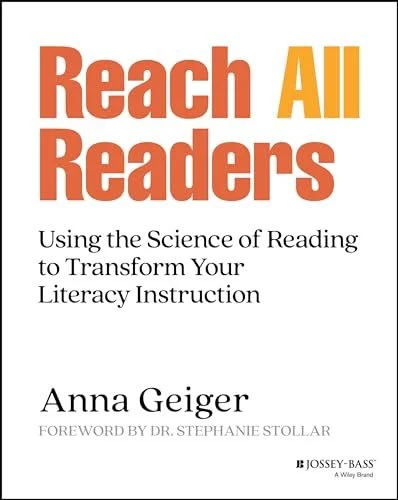
Reach All Readers: Using the Science of Reading to Transform Your Literacy Instruction
by Anna Geiger
A practical guide written by an experienced teacher who describes her journey towards ‘structured literacy’
In Reach All Readers, Anna Geiger, a former teacher from the US and presenter of the excellent Reach All Readers podcast (reviewed here), describes her journey from a ‘balanced literacy’ approach to a ‘structured literacy’ approach. Her friendly tone and candid acknowledgment of her own mistakes make for an engaging read.
What it’s about
Anna Geiger begins with a brief introduction to the ‘reading wars’, including descriptions of a ‘whole language’ approach and ‘balanced literacy’. She explains that many trainee teachers, including herself, were not taught the most effective ways of teaching reading, and therefore they found it difficult to support struggling readers in their classes.
The author introduces the idea that research can and should inform how we teach literacy, and then explains some of the main frameworks that are useful for literacy teachers: the Simple View of Reading, Scarborough’s Rope, and Ehri’s phases of word learning.
Chapter 2 focuses on what Geiger calls the ‘science of learning’, which goes beyond literacy and into good practice for all educators. She introduces the concepts of long-term memory, working memory and cognitive load theory, and then describes their implications for teaching – specifically, explicit instruction, increasing participation, scaffolding, feedback and retrieval practice. These are carefully exemplified in terms of how teachers could implement them in a phonics lesson.
Subsequent chapters each focus on a different component of literacy: oral language, phonemic awareness, phonics, fluency, vocabulary, and comprehension. In each case, the main concepts and terminology are introduced in a teacher-friendly way, and then examples of activities or short scripts are used to show how to implement the key ideas.
A chapter on linking reading and writing is also included, touching on handwriting, spelling, and the benefits of helping children to write about what they have read.
Finally, there is a short chapter on dyslexia, and on how effective approaches to literacy can be implemented at a school-level using multi-tiered systems of support (MTSS).
The best bits
Clear explanations accompanied by specific examples make this a very practical introduction for teachers. The occasional conversational tone and references to personal experience are engaging, and help the reader feel part of a community or learners, rather than being lectured to.
The less good
Occasional errors such as not including /ā/ /ī/ and /ō/ as diphthongs might grate with some readers.
Who is it for?
The examples and activities described in the book are suitable for young children learning to read, so I’d recommend Reach All Readers to primary teachers, particularly those who are new to research-based approaches to teaching. It doesn’t go into much depth on any topic, so teachers who are familiar with the basics may prefer slightly more detailed texts such as Mark Seidenberg’s Language at the Speed of Sight (reviewed here) or Chris Such’s The Art and Science of Teaching Primary Reading (reviewed here). However, for an engaging and teacher-friendly introduction, Reach All Readers is a good starting point.