
The problem with requiring ‘fidelity’ when implementing phonics programmes
Introduction
In September, the Welsh Government published its Foundational Literacy and Numeracy Plan, which includes the expectation that all schools should use systematic, synthetic phonics as part of their approach to teaching reading. Although I welcome the focus on systematic phonics, this post expresses my concern that the accompanying emphasis on “effective delivery of phonics programmes with fidelity” may be unnecessarily restrictive, preventing teachers from using their expertise to improve and supplement phonics provision. In particular, I discuss why integrating morphology, etymology and orthographic conventions within phonics programmes is likely to be beneficial. The key point is that a phonics programme should be a foundation for teachers to build on, not a ceiling that limits what they are allowed to teach.
I’ll start by stating explicitly that I’m not anti-phonics. The latest PISA results clearly show that the Welsh education system should learn lessons from what is going right in England, and that includes ensuring that phonics is taught systematically. However, as I explain below, phonics programmes often have limitations, and teachers need the freedom to adapt programmes to meet students’ needs, particularly as further evidence of the best ways to teach reading and spelling emerges.
I’ve structured the post as follows:
Section 1. The complexity of the English spelling system is not fully captured by most phonics programmes
Section 2. Research demonstrates that teaching morphology, etymology and orthographic conventions can benefit reading and spelling
Section 3. A rigid phonics programme may not be the best way of developing reading and spelling skills for some students
Section 4. To what extent do phonics programmes already include morphology, etymology and orthography?
Section 5. Conclusions
Section 1. The complexity of the English spelling system is not fully captured by most phonics programmes
In essence, phonics programmes teach pupils the correspondences between graphemes (letters or letter-sequences) and phonemes (individual sounds in words*). However, the English spelling system doesn’t work just by matching graphemes to phonemes – there’s more to it than that. English spelling is strongly influenced by morphology and etymology, and there are also some important spelling patterns (or, more formally, orthographic conventions).
The complex nature of the English spelling system means that a rigid synthetic phonics approach can be a problem because it encourages the expectation that there should always be a correspondence (or ‘match’) between graphemes and phonemes, and this simply isn’t true in English.
In the following sections, I’ll explore this in more detail with some specific examples that demonstrate when reliance on grapheme-phoneme correspondences (GPCs) might cause confusion, meaning that learners need to draw on knowledge of etymology, morphology and orthographic conventions to understand spelling.
Section 1A. Graphemes are not always pronounced
Firstly, graphemes are not always pronounced in English, so there is sometimes no phoneme for a grapheme to correspond to! Here are a couple of examples that draw on etymology to explain why a grapheme may not be pronounced in Modern English.
Etymological example 1 – two
In some instances, a letter was pronounced in the past, but it’s no longer pronounced in Modern English. For example, the <w> in two was pronounced in its Old English ancestor twa. The <w> has been retained in the spelling in Modern English for several reasons. Firstly, when you are reading, it distinguishes two from to and too. Secondly, it highlights the relationship with other words beginning with <tw> that are related to the word twa and have a meaningful connection to “two” e.g. twice, twelve, twenty, twin, twine.
<w> is therefore a grapheme that doesn’t represent a phoneme in Modern English. Instead, <w> functions to distinguish homophones and to mark an etymological connection to other words.
Etymological example 2 – doubt
In some cases, words include letters that were never intended to represent a sound. For example, doubt has an unexpected letter <b>. This was added in the 14th to 16th century by scribes who were keen that English spellings should reflect their Latin origins – in this case, the root dubitare. So, <b> is a grapheme that simply reflects the history of the word – this kind of grapheme is called an etymological marker.
Section 1B. Some graphemes reflect morphology, not pronunciation
In English, sometimes the morphological structure of a word overrides the pronunciation when it comes to spelling. So, again, a rigid focus on GPCs can be misleading.
Morphological example 1 – <-ed>
If pupils relied purely on GPCs, jumped would be spelled as <jumpt>, failed as <faild> and rested as <restid>. This is because we pronounce <‑ed> as /t/ /d/ or /ɪd/ depending on the sound that comes before it. Despite the different pronunciations, the correct spelling is <‑ed>. <‑ed> is a suffix that indicates the past tense (e.g. I failed my exams) or an adjective (e.g. As a failed politician, he found it hard to get another job). Therefore, <-ed> reflects meaning, rather than pronunciation.
Morphological example 2 – does
The word does is sometimes spelled phonetically as <duz>. I’ve also come across many pupils who spell it as <dose> – presumably because they know that does is a bit odd and it includes an <e>, and they are in the habit of putting <e> onto the end of words! However, let’s look at the morphological structure of does using a word sum:
do + es → does
The word sum highlights the meaningful connection of does to the word do, and it uses the common suffix <-es> to indicate the third person. So, the spelling is perfectly regular; it’s the pronunciation that is a bit odd.
Morphological example 3 – question
Question includes the /ʧ/ “ch” phoneme, which a pupil’s knowledge of GPCs would lead them to expect is likely to be spelled as <ch>. So why is it spelled with <t>? Again, the answer lies in morphology:
quest + ion → question
The base is <quest>, reflecting the meaning of the word question as a quest to find an answer. And <‑ion> is a common suffix indicating nouns.
Section 1C. GPCs may depend on orthographic conventions relating to syllable-position, word-position or adjacent letters
Spelling can be tricky in English because there are multiple ways of spelling many phonemes. For example, /ɔɪ/ can be spelled as <oi> as in coin or <oy> as in boy. Choosing the correct grapheme often depends on syllable position or word position. These spelling patterns are also sometimes called positional constraints.
In addition, many graphemes can be pronounced in multiple ways, and the correct pronunciation is sometimes dependent on syllable-position, word-position or adjacent letters.
Here are just a few examples of orthographic patterns that are useful for pupils to know:
Syllable position example – <ck>
When spelling, it’s helpful to know that /k/ can be spelled as <ck> at the end of syllables (e.g. stick, pocket) but not at the start of syllables (e.g. king, cat).
Word position example – <er>
In Standard Southern British English, if a pupil is reading the word servant, <er> is pronounced as /ɜː/. If they are reading corner, <er> is pronounced as /ə/. If pupils know that <er> is often pronounced as /ɜː/ in the middle of words but /ə/ at the end of words, they will more easily recognise servant and corner. (At the end of words <er> is also very likely to be an agentive suffix or a comparative suffix, e.g. waiter, stronger.)
Adjacent letter example – <c>
Imagine that a pupil is trying to read the word recite. If they are confident with their GPCs, they will know that <c> can correspond to /k/ (as in cat) or /s/ (as in cell) but they may not be sure which is the correct pronunciation in the word recite. However, if they are aware of the orthographic convention that <c> represents /s/ when it is next to a letter <e>, <i> or <y>, then they can confidently sound out the word.
Summary of Section 1
The key point is that to understand how graphemes relate to phonemes, you need to know some morphology, some etymology and some orthographic conventions – they are interdependent. That is, it can be confusing if you just teach the grapheme-phoneme correspondences initially, and then ‘top up’ with morphology, etymology and orthography later. If you try that, then the weaker pupils can get really frustrated and think that English spelling doesn’t make sense.
For this reason, insisting on fidelity to a programme that is designed with a rigidly phonics-first approach may not encourage best practice. Instead, integrating instruction in morphology, etymology and orthographic conventions within a phonics programme has the potential to prevent the frustration that so many learners feel when they encounter ‘exceptions’ to the GPCs that they have been taught.
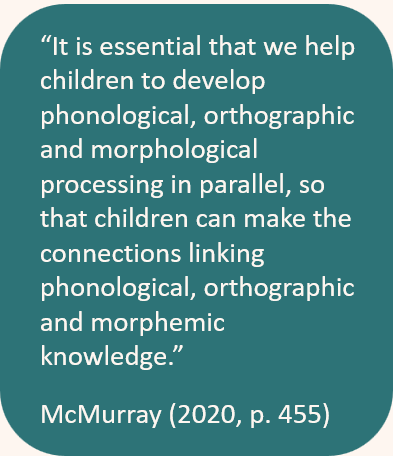
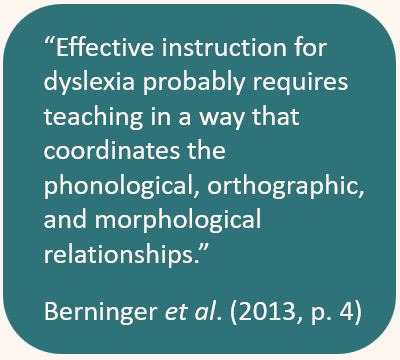
In the quotes below, these researchers emphasise the importance of integrating multiple components when teaching reading and spelling:
Section 2. Research demonstrates that teaching morphology, etymology and orthographic conventions can benefit reading and spelling
The examples in Section 1 showed why knowledge of etymology, morphology and orthography may help pupils to understand the English spelling system. In this section, I take a brief look at some of the research that shows teaching morphology, etymology and orthographic conventions can benefit reading and spelling.
Section 2A. Meta-analyses that assess the effectiveness of morphology instruction
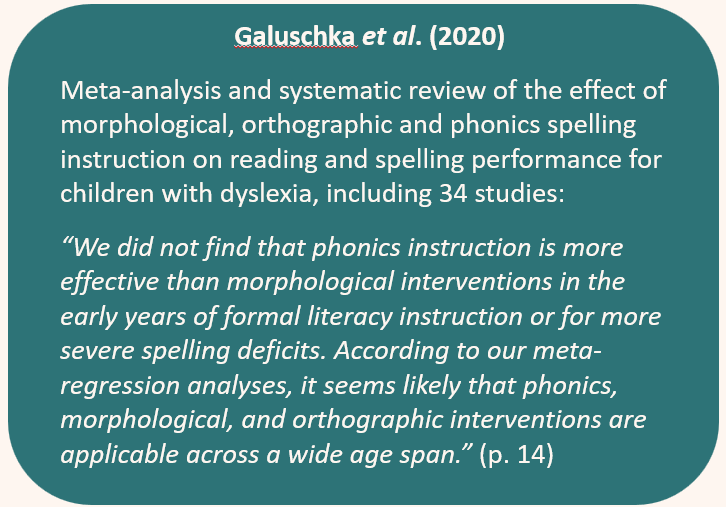
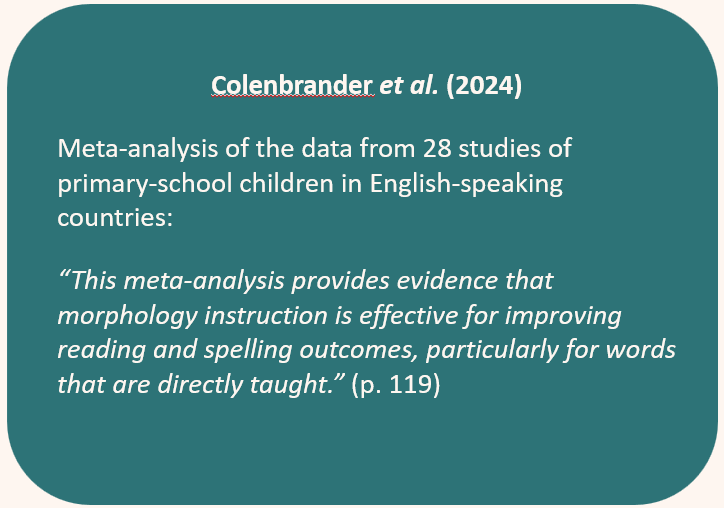
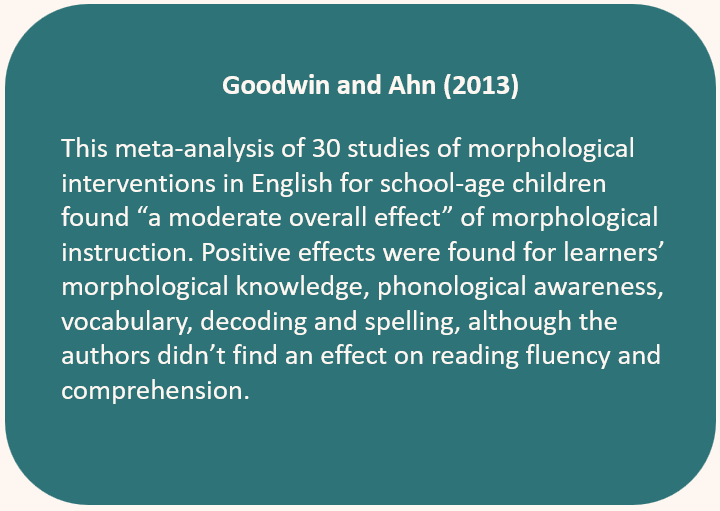
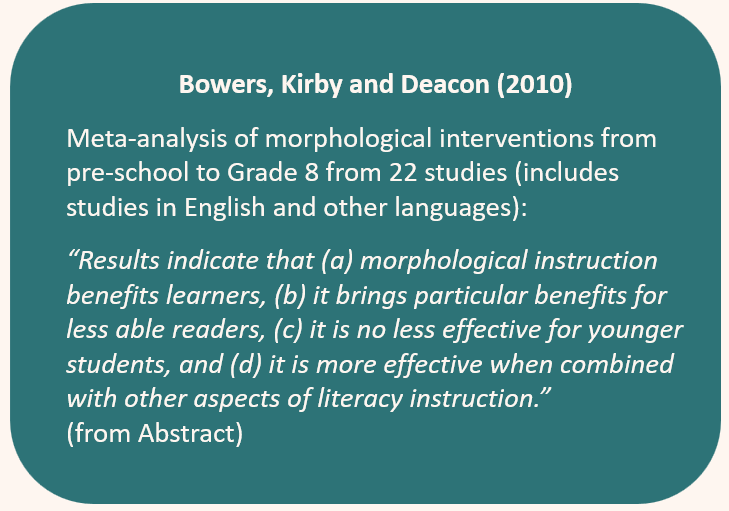
Meta-analyses bring together the data from multiple papers to try to reach more definitive conclusions than can be achieved through individual studies. Meta-analyses of ‘morphological instruction’ need to be treated with caution for several reasons (see my blog post for further discussion). Nevertheless, the research papers that I mention below show that morphological instruction needs to be taken seriously as part of an effective approach to teaching reading and spelling, even in the early stages of learning to read.
Section 2B. Specific studies
Research interest in teaching reading and spelling using morphology, etymology and orthographic conventions has increased recently. Here, I briefly highlight two studies that show how instruction in these elements has successfully improved reading and/or spelling for pupils of different ages in different settings.
Years 1 and 2 – classroom environment
Devonshire et al. (2013) conducted a study comparing two methods of instruction with a total of 120 pupils from Years 1 and 2 at a primary school in England. Instruction was delivered in a classroom environment with 15 pupils.
First, baseline measurements of reading and spelling were established (Time 1). Then, the Intervention First group was taught reading and spelling using etymology, morphology and rules about word form, with instruction also including discussion of GPCs. At the same time, the Intervention Second group of pupils was taught phonics as usual for six weeks using Department of Education ‘Letters and Sounds’ resources. The reading and spelling performance of both groups was assessed (Time 2). Then the groups were switched before being assessed for a third time (Time 3).
Results showed that the Intervention First group outperformed the Intervention Second group for both reading and spelling assessments at Time 2. By Time 3, the Intervention Second group had caught up.
The authors conclude:
“We suggest that our results do provide evidence that morphology, etymology, phonology and form rules can and should be included from the start of formal English literacy instruction” (p. 94).
7-to-9 year-olds – one-to-one teaching of a specific rule
In a smaller-scale study, Burton et al. (2021) studied 90 pupils while they learned a spelling convention in a one-to-one setting. Pupils were taught that the spelling of a stem is conserved when a suffix is added, even if the pronunciation changes. For example, the word magician derives from the stem magic, but the pronunciation of the <c> changes from /k/ to /ʃ/ when the suffix <-ian> is added.
magic + ian → magician
There were three groups of 7-to-9 year-olds, Explicit, Implicit and Control. In the Explicit group, pupils viewed slides that displayed word stems (e.g. magic), and the children were asked how they thought derivatives (e.g. magician) should be spelled. They were then shown the correct spellings, and were taught about the connection between stems and their derived spellings. After that, they completed a practice game in which they spelled derived words after seeing the base forms. In the Implicit condition, pupils were exposed to the same slides and practice game without explicit teaching. Control pupils were not exposed to the taught words.
Results showed that the Explicit group performed significantly better than Implicit and Control groups at spelling untaught derived words (e.g. musician) and derived pseudo-words (e.g. donician). This difference was significant at both immediate and delayed post-tests.
Summary of Section 2
In summary, there is research evidence that teaching using morphology, etymology and/or orthographic rules can improve reading and/or spelling performance for pupils of different ages in a variety of settings. Although more evidence is needed, particularly for older students, and especially for etymology, there are strong indications that adding other components to phonics teaching is likely to be beneficial.
Therefore, if morphology, etymology and orthographic conventions are not a part of an existing phonics programme, then we need to allow teachers to integrate them without being penalised for ‘infidelity’.
Section 3. Fidelity to a phonics programme may not be the best way of developing reading and spelling skills for some students
The word ‘fidelity’ seems odd in the context of teaching programmes. It seems to imply that a teacher should blindly follow a programme, with no autonomy or consideration of whether it is actually the best approach for the specific needs of the pupils in front of them. As I discuss in this section, both struggling learners and very able learners may have particular requirements when learning to read and spell.
Section 3A. Learners with phonological processing difficulties and other language difficulties may benefit from other methods
Naturally enough, learners with phonological processing difficulties often struggle with phonics. Phonological processing difficulties are considered to be the core deficit in most learners with dyslexia (Carroll et al. 2025). These students may find it difficult to segment words into phonemes, blend phonemes together, or to hold phonemes in memory for long enough to recognise a word.
For some pupils who struggle, extra practice in phonics or a slower pace of phonics teaching may be sufficient to achieve a reasonable standard of reading and spelling. However, for those who really struggle to blend and segment words, persisting with phonics as the primary focus of an intervention can be unproductive and demotivating. These students may make progress with approaches that include a greater emphasis on morphology (Galuschka et al. 2020).
I recommend listening to this episode of For the Love of Literacy for a graphic description of how seemingly endless phonics interventions can discourage pupils who struggle to read and spell.
Section 3B. Very able pupils may be held back by excessive phonics teaching
A few very able pupils can learn to read and spell successfully with only very minimal explicit phonics instruction. If these pupils are limited by a phonics programme that progresses at a slow pace (for them), they may be more limited in the books that they are reading independently than would otherwise be the case, restricting development of their vocabulary and background knowledge (Dilgard et al. 2022, pp. 561–562).
Summary of Section 3
Explicit instruction in morphology, etymology and orthography may be particularly relevant for preventing difficulties for students who struggle with reading and spelling. Adapting instruction to best suit the needs of struggling pupils or very able pupils may involve teachers departing from a phonics programme. This should not be penalised as a lack of ‘fidelity’.
Section 4. To what extent do phonics programmes already include morphology, etymology and orthography?
So far in this blog post, I’ve discussed why integrating morphology, etymology and orthographic conventions alongside phonics may be beneficial. But to what extent do widely-used phonics programmes already do this? My impression (without a systematic analysis, as most programmes require payment for access) is that widely-used phonics programmes vary a lot in the extent to which they teach morphology and orthographic conventions, and they don’t seem to include much etymology.
Section 4A. A brief look at selected phonics programmes
Here are just a few examples of how some widely-known phonics schemes incorporate these components:
Basic morphology is taught in some programmes. For example, Letters and Sounds** teaches the suffix <-ed>, but not until Phase 6 (Year 2) after most GPCs have been learned. Similarly, Jolly Literacy includes the <-ed> suffix, but Jolly Literacy is not taught until after the Jolly Phonics scheme, in which most GPCs are learned.
Orthographic conventions are taught in Letters and Sounds. In Phase 6 (Year 2), pupils are taught ‘drop <e>’, doubling and ‘<y> to <i>’ suffixing conventions, along with patterns such as <v> being followed by <e> at the end of words (e.g. give). Suffixing conventions are also taught within the Jolly Literacy programme.
Positional constraints on graphemes are central to some programmes – for example, they are integral to GPC teaching within UFLI Foundations (the University of Florida Literacy Institute’s free phonics programme).
Even the authors of the Sounds-Write programme, which has a very strong emphasis on GPCs, acknowledge that etymology can be helpful:
“When teaching pupils to read and spell we find no difficulty in discussing the above issues [sound change over time] with them. They usually find such discussions interesting because it increases their general knowledge and understanding of the English language. Most importantly, it also gives them appropriate memories that facilitate their future accurate spelling of these 'unusual' words.” (Philpot, Wilmot and Case, 2011, p. 31)
However, I am unclear whether the Sounds-Write programme actually provides teachers with the etymological information that they need in order to use etymology in their classroom practice.
Unfortunately, some phonics programmes also include approaches that are unlikely to be helpful. For example:
Some programmes teach /ʃən/ (“shun”) as a unit without reference to its morphological structure. That is, they teach a word such as action without explaining that <t> is at the end of a base, and <-ion> is a suffix (e.g. act + ion → action).
Other programmes teach unreliable ‘rules’ such as ‘open’ and ‘closed’ syllables as an indicator of how to pronounce vowel graphemes. (See Kearns (2020) for a discussion of open and closed syllables.)
Section 4B. A fairly rigid approach to phonics is still widespread
Despite increasing awareness of the impact of morphological instruction, and some teaching of orthographic conventions, a fairly rigid approach to phonics seems common in widely-used programmes. So, for example, the educators featured in this podcast episode, based on experience of English schools, describe pupil experiences that reflect programmes and interventions with a very strong focus on learning GPCs, rather than looking at the writing system more broadly.
A recent paper examining the difference between phonics programmes also reflects a very strong focus on GPCs, and perhaps a lack of consideration of integrating other components alongside phonics. Ungerer et al. (2026) analysed three programmes – Letters and Sounds, Jolly Phonics, and Read Write Inc. Their focus was on the GPCs that are taught in these programmes, the order of teaching GPCs, what words to use as examples, and when to introduce ‘exception words’. They found substantial differences between the programmes, reinforcing the notion that systematic synthetic phonics programmes in their current form may not be optimal.
However, surprisingly, their paper included no mention of etymology and only a few references to morphology, one of which mentioned “complex morphological curricula” being “very challenging to deliver” (p. 503). Given the variety of ways in which morphology can be incorporated into a curriculum, this seems unnecessarily dismissive. In addition, although the authors discuss when these phonics programmes teach ‘exception words’, they do not consider whether an alternative approach might reduce the need for teaching ‘exceptions’. In particular, ‘exception words’ are approached as words to memorise rather than explain. Furthermore, their section on ‘open questions in phonics instruction’ (pp. 499–500) does not include questions about the best ways to teach exception words, or when to introduce morphology.
Summary of Section 4
Without full access to a range of phonics programmes, it is difficult to give a thorough analysis of the extent to which they incorporate morphology, etymology and orthography alongside phonics. However, the picture seems very mixed, and etymology in particular is neglected. Certainly, teaching the interdependence of phonology, morphology, etymology and orthography (as described in Section 1) in order to avoid perceived ‘exceptions’ to GPCs seems under-appreciated.
Section 5. Conclusions
Awareness of the benefits of integrating other components alongside phonics is increasing
Awareness of the usefulness of explicit teaching of morphology, etymology and orthographic conventions for understanding the English writing system is increasing, particularly through the work of experts such as Dr Peter Bowers, Sue Hegland, Lyn Stone and Louise Selby. Research into the effectiveness of teaching approaches that incorporate these components is also growing.
The importance of morphology, etymology and orthography is not an argument against teaching systematic synthetic phonics. Indeed, a systematic phonics programme is essential for most teachers, who tend to be non-specialists and short on time. However, it is an argument against rigid insistence on ‘fidelity’ to a phonics programme that may be sub-optimal. A requirement for fidelity is surely based on the assumption that a school’s phonics programme is definitely the best way of teaching reading and spelling for all pupils. But – as I hope this blog post has highlighted – this is not necessarily the case.
And, talking of other components, I hope it goes without saying (but I’ll say it just in case!) that learning to decode and encode words must be accompanied by exploring the meaning of words, sentences and whole texts – and, of course, simply enjoying stories!
The importance of continuing research
It’s also important to continue research into the best way of teaching GPCs and, particularly, ‘exception words’. For example, The High Frequency Word Project, created by Fiona Hamilton and Rebecca Loveless, has a strong emphasis on morphology and etymology (‘telling the tale’) for young pupils – alongside analysing the graphemes in words. And some programmes, my own included, do this for older readers alongside systematic phonics. However, these haven’t been explicitly evaluated by research.
We also need to ensure that researchers pay attention to the big picture when evaluating the effectiveness of programmes. In this blog post, I’ve focused on the role of morphology, orthographic knowledge and etymology in improving reading and spelling outcomes. However, it’s also important to consider the impact on vocabulary – and this is where morphology is likely to have a particularly strong impact (e.g. Gellert et al. (2020); see also my blog post about effective vocabulary teaching).
What are the implications for literacy teaching in Wales?
I started this blog post with reference to my concerns about the emphasis on “effective delivery of phonics programmes with fidelity” in the newly-published Foundational Literacy and Numeracy Plan. So, what do I think needs to happen?
As a general point, it’s often considered that Curriculum for Wales places too much of a burden on schools to design their own curricula (e.g. this 2025 Welsh government report). However, I would not want the Welsh government to go to the other extreme and have teachers unable to bring their expertise to bear without being penalised for lack of ‘fidelity’ to a phonics programme that may be sub-optimal. Whether this becomes an issue will partly depend on how ‘fidelity’ is judged by Estyn (the Welsh equivalent of Ofsted), and the extent to which Estyn is prepared to acknowledge and value teachers’ expertise.
Systematic synthetic phonics programmes – though very important – are not beyond improvement, and blindly following a programme is unlikely to be the best approach for all pupils. Instead, let’s ensure that teachers have the training they need to develop expertise in the complexity of the English spelling system, and to understand how a programme may need to be adapted to meet the particular needs of every student.
Click the button to find out more about LIfTT, which is a multicomponent intervention for adolescents that includes a structured phonics programme that integrates morphology, etymology and orthographic conventions.
Footnotes
*Technically, a phoneme is an abstract representation of the phonological units that distinguish words, e.g. /kæt/ cat vs /pæt/ pat. However, thinking of phonemes as the individual sounds in words is convenient for most teaching purposes.
**Letters and Sounds is not really a complete phonics programme because it doesn’t include teacher training and ready-made lesson plans.
References
Berninger, V.W., Lee, Y., Abbott, R.D., & Breznitz, Z. (2013). Teaching children with dyslexia to spell in a reading-writers’ workshop. Annals of Dyslexia, 63, 1 - 24.
Bowers, P. N., Kirby, J. R., & Deacon, S. H. (2010). The effects of morphological instruction on literacy skills: A systematic review of the literature. Review of Educational Research, 80(2), 144–179. https://doi.org/10.3102/0034654309359353
Burton, L., Nunes, T. and Evangelou, M. (2021), Do children use logic to spell logician? Implicit versus explicit teaching of morphological spelling rules. Br J Educ Psychol, 91: 1231-1248 e12414. https://doi.org/10.1111/bjep.12414
Carroll, J.M., Holden, C., Kirby, P., Thompson, P.A., Snowling, M.J. and the Dyslexia Delphi Panel (2025), Toward a consensus on dyslexia: findings from a Delphi study. J Child Psychol Psychiatr, 66: 1065-1076. https://doi.org/10.1111/jcpp.14123
Colenbrander, D., von Hagen, A., Kohnen, S., Wegener, S., Ko, K., Beyersmann, E., Behzadnia, A., Parrila, R., & Castles, A. (2024). The effects of morphological instruction on literacy outcomes for children in English-speaking countries: A systematic review and meta-analysis. Educational Psychology Review, 36(4), Article 119. https://doi.org/10.1007/s10648-024-09953-3
Devonshire, V., Morris, P.H., & Fluck, M.J. (2013). Spelling and reading development: The effect of teaching children multiple levels of representation in their orthography. Learning and Instruction, 25, 85-94.
Dilgard, C. & Hodges, T. (2022). Phonics Instruction in Early Literacy: Examining Professional Learning, Instructional Resources, and Intervention Intensity. Reading Psychology. 43. 541-575. https://doi.org/10.1080/02702711.2022.2126045.
Galuschka, K., Görgen, R., Kalmar, J., Haberstroh, S., Schmalz, X., & Schulte-Körne, G. (2020). Effectiveness of spelling interventions for learners with dyslexia: A meta-analysis and systematic review. Educational Psychologist, 55(1), 1–20. https://doi.org/10.1080/00461520.2019.1659794
Gellert, A.S., Arnbak, E., Wischmann, S., & Elbro, C. (2021). Morphological Intervention for Students With Limited Vocabulary Knowledge: Short- and Long-Term Transfer Effects. Reading Research Quarterly, 56(3), 583–601. https://doi.org/10.1002/rrq.325
Goodwin, A. P., & Ahn, S. (2013). A meta-analysis of morphological interventions in English: Effects on literacy outcomes for school-age children. Scientific Studies of Reading, 17(4), 257–285. https://doi.org/10.1080/10888438.2012.689791
Kearns, D.M. (2020). Does English Have Useful Syllable Division Patterns?. Reading Research Quarterly, 55(S1), S145–S160. https://doi.org/10.1002/rrq.342
McMurray S. (2020) Learning to spell for children 5–8 years of age: The importance of an integrated approach to ensure the development of phonic, orthographic and morphemic knowledge at compatible levels. Dyslexia. 2020; 26: 442–458. https://doi.org/10.1002/dys.1663
Philpot, D., Walker, J. and Case, S. (2011). English Spellings: A Lexicon. Published by Sounds-Write Ltd.
Ungerer, T., Rastle, K., & Armstrong, B. C. (2026). Bringing the Reading Sciences Into the Classroom: Insights for Phonics Instruction. Perspectives on Psychological Science, 21(5), 488-510. https://doi.org/10.1177/17456916261438004